Skip to content
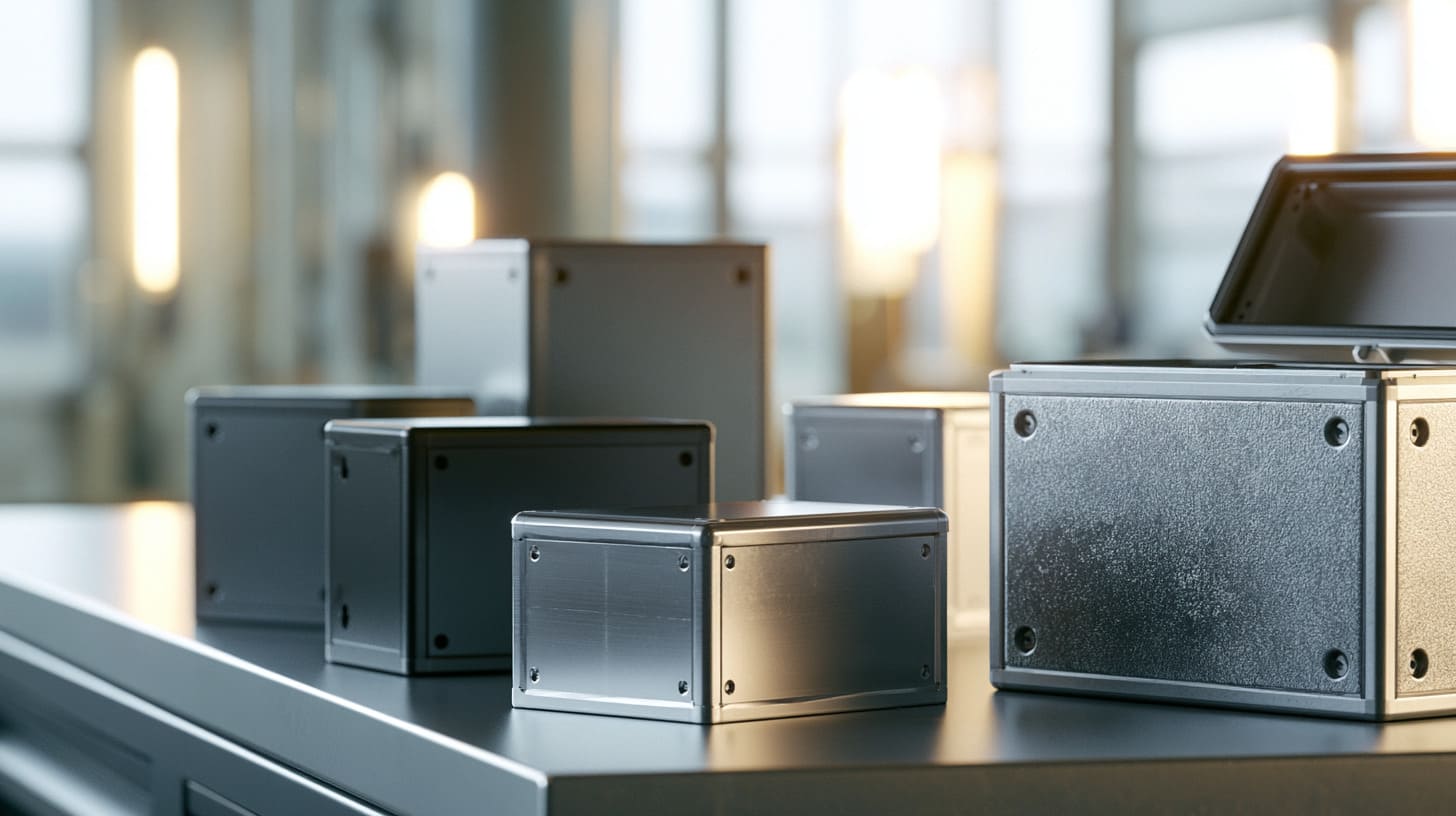
A buyer once sent me a drawing for an aluminum enclosure and wrote only one short note: “black coating required.”
That sentence looked simple. Very simple.
But after I checked the application, the project was not simple at all. The enclosure would be used outdoors. It needed gasket sealing. It also needed grounding points inside. The customer wanted a clean black surface, but the engineering team also needed good electrical contact and stable heat transfer.
So I asked a few questions.
Where will the enclosure be installed?
Will it face rain or salt air?
Does the PCB need grounding through the housing?
Are there any tight sliding rails or threaded holes?
Is the black color for appearance only, or does it have a brand color requirement?
The buyer paused for a while. Then he said, “I thought coating was just coating.”
This is a very common misunderstanding in aluminum enclosure projects.
Surface coating is not just about making the enclosure look better. It affects corrosion resistance, appearance, grounding, EMI shielding, heat transfer, tolerance, assembly fit, and cost. A coating can protect the product. It can also create new problems if we choose it too early.
For me, the coating choice should not start from a color chart. It should start from the real working condition of the enclosure.
In this article, I will explain the common types of surface coatings used in aluminum enclosures. I will also share how I usually judge them in real OEM and ODM projects, especially when customers send custom drawings and ask us to manufacture enclosures with logo, brand color, and functional requirements.
By the end, you should not only know the coating names. You should also know when each coating makes sense, where it can go wrong, and what information you should confirm before quotation or production.
What Are Surface Coatings for Aluminum Enclosures?
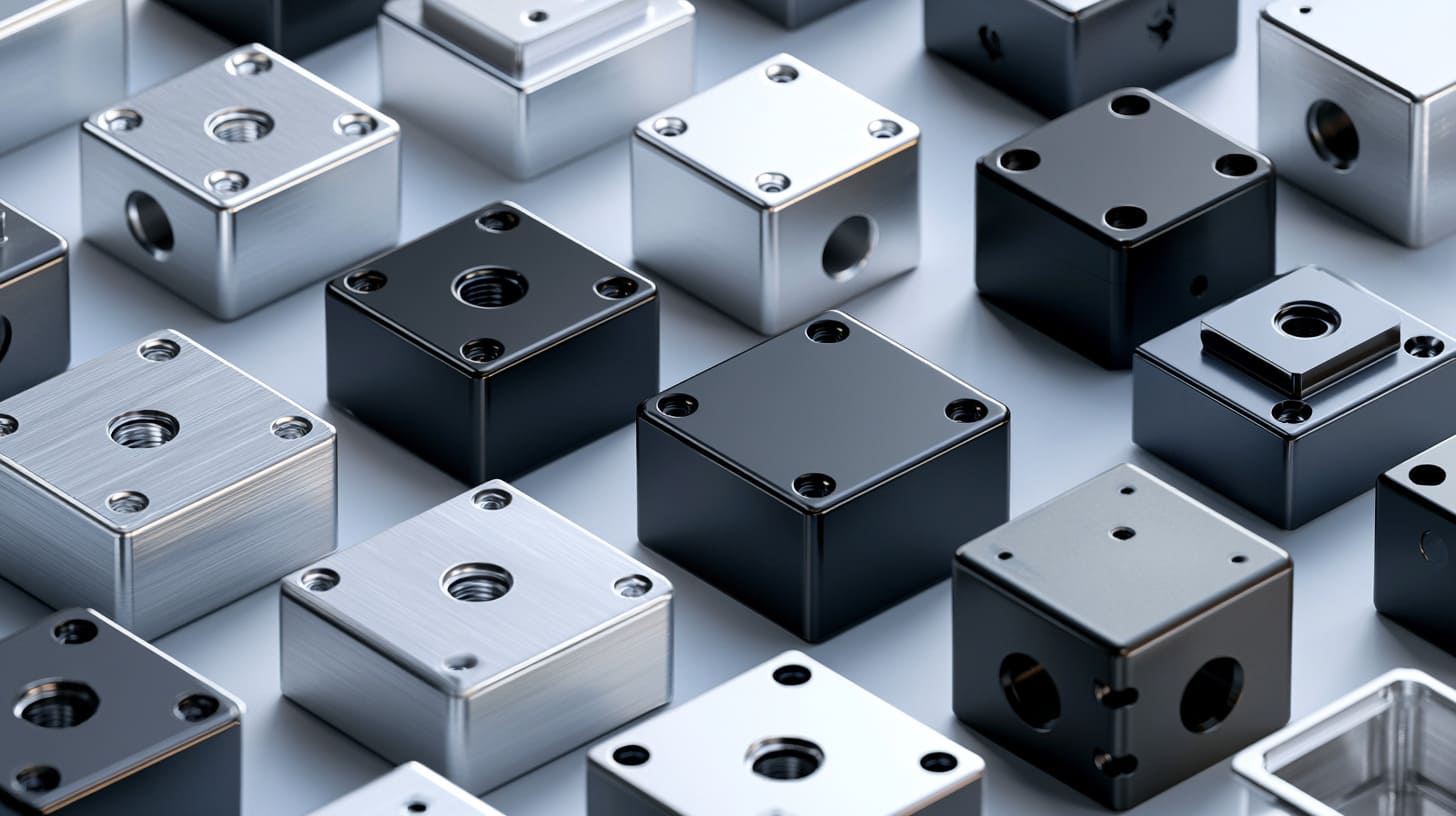
Surface coatings for aluminum enclosures are protective or decorative layers applied to the aluminum surface. Some coatings improve corrosion resistance. Some improve appearance. Some help with electrical function. Some are mainly used to control wear, color, or texture.
But I do not like to explain coating only by definition. In real projects, coating is always connected with the final use of the enclosure.
A small indoor sensor housing does not need the same surface treatment as an outdoor communication box. A Raspberry Pi style aluminum case does not need the same finish as a large sheet metal control cabinet. A black branded enclosure for retail sale also has different requirements from an internal industrial housing hidden inside a machine.
The first mistake I try to avoid is treating all aluminum enclosures as the same product just because they use the same base material.
Surface coating vs surface treatment
Many buyers use the words “coating,” “finish,” and “surface treatment” in the same way. I understand why. In daily communication, it is faster.
But in manufacturing, there is a useful difference.
Some processes change the aluminum surface itself. Anodizing is a good example. Chemical conversion coating is another example. These processes react with the aluminum surface and form a thin layer.
Other processes add a separate layer on top of the aluminum. Powder coating and wet painting belong to this group.
Here is a simple way to compare them:
| Type | How it works | Common examples | Main purpose |
|---|---|---|---|
| Surface treatment | Changes or reacts with the aluminum surface | Anodizing, chem film | Protection, appearance, conductivity control |
| Surface coating | Adds a layer on top of the aluminum | Powder coating, wet painting | Color, protection, branding |
| Mechanical finish | Changes surface texture | Brushing, polishing | Appearance, texture, visual effect |
| Plating | Adds a metallic layer | Electroless nickel, chrome | Wear resistance, function, special protection |
This difference matters because each process affects the enclosure in a different way. A thick powder coating may affect a sliding cover. A thin chem film may keep conductivity but will not give the same beautiful appearance as black anodizing or matte powder coating.
Why aluminum still needs surface protection
Aluminum naturally forms a thin oxide layer when exposed to air. This is one reason aluminum is popular for enclosures.
But this natural layer is not always enough.
I have seen customers assume that “aluminum does not rust,” so the enclosure should be fine outdoors. That is only partly true. Aluminum does not rust like steel, but it can still corrode, stain, pit, or lose its clean appearance under harsh conditions.
Common risks include:
- Salt spray near coastal areas
- UV exposure outdoors
- High humidity
- Acid or alkaline cleaning liquids
- Fingerprints and handling marks
- Scratches during assembly
- Chemical vapor in industrial sites
- Abrasion during use or maintenance
For an indoor electronics case, these risks may be small. For an outdoor enclosure near the sea, they can become serious.
Key selection factors before choosing a coating
Before I suggest a coating, I usually want to know a few basic details.
| Question | Why I ask it |
|---|---|
| Is the enclosure used indoors or outdoors? | Outdoor use needs stronger corrosion and UV thinking |
| Is there salt, rain, dust, or chemical exposure? | Harsh environments can change the coating choice |
| Does the product need a brand color? | Powder coating or painting may be better for color matching |
| Does the enclosure need grounding or EMI shielding? | Non-conductive coating may block electrical contact |
| Does the enclosure need heat dissipation? | Thermal contact areas may need masking |
| Are there tight holes, threads, grooves, or rails? | Coating thickness can affect assembly |
| What is the order quantity? | Some coating processes are not cost-effective for small runs |
A coating choice is never only a surface decision. It is also a design decision.
I often tell customers this: if we choose the coating after we understand the application, we solve problems early; if we choose it only by appearance, we may pay for those problems later.
A good coating can make a product look finished. A wrong coating can make a good design feel careless.
Anodizing for Aluminum Enclosures
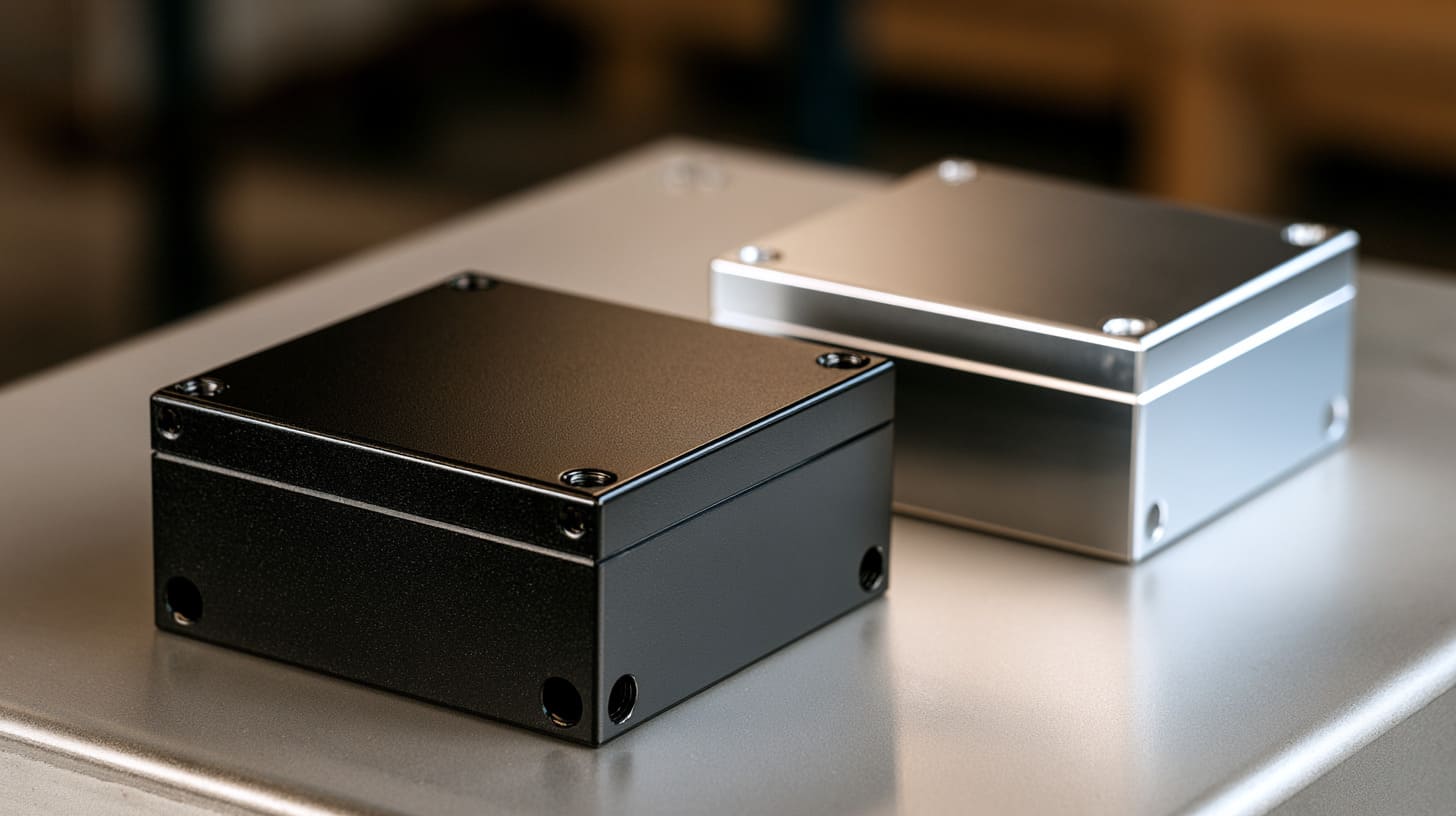
Anodizing is one of the most common surface treatments for aluminum enclosures. It is especially popular for extruded aluminum enclosures, CNC-machined aluminum housings, front panels, and electronic cases.
The reason is simple. Anodizing keeps the aluminum look. It does not cover the metal like paint. It gives the surface a cleaner, harder, and more professional appearance.
When a customer wants a product that still looks like aluminum, anodizing is often the first option I consider.
The detail that I do not ignore is alloy and batch control, because two parts can both be “black anodized” but still look slightly different when the material source or process changes.
What anodizing does
Anodizing creates a controlled aluminum oxide layer on the surface. This layer becomes part of the aluminum. It is not a separate film like paint.
This is why anodized parts still feel metallic. You can see the material character. You can also keep sharp edges, clean lines, and a premium industrial look.
For many small electronics enclosures, this finish works very well. It looks neat. It does not feel too heavy. It also gives better wear resistance than raw aluminum.
Common anodizing types for enclosures
Different anodizing options fit different projects.
| Anodizing type | Common use | Main benefit | Main concern |
|---|---|---|---|
| Clear anodizing | Natural aluminum cases, panels | Clean metallic look | May show material marks |
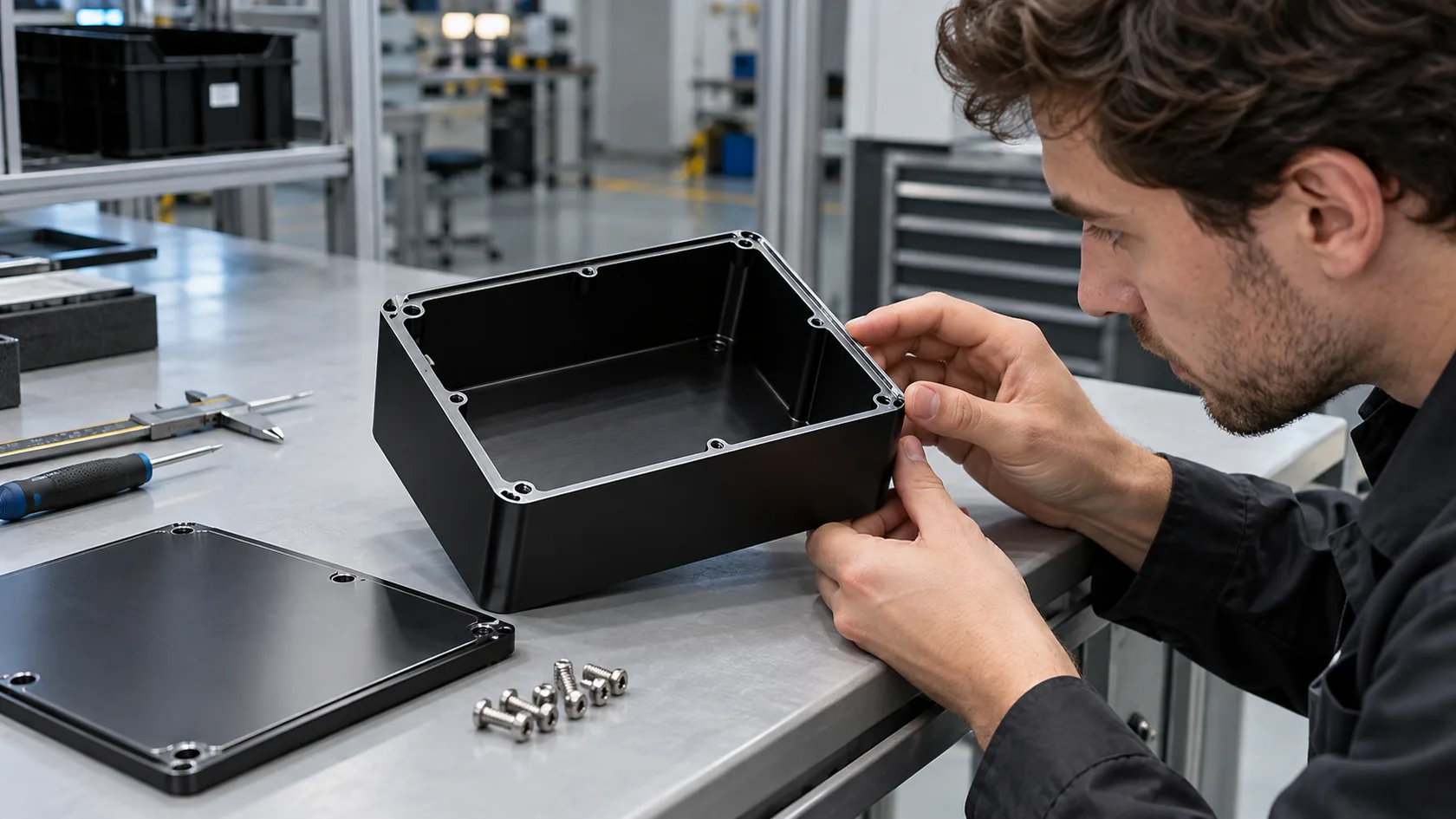
| Black anodizing | Electronics, industrial devices | Professional appearance | Color consistency must be checked |
| Hard anodizing | Wear parts, rugged housings | Better hardness and wear resistance | Higher cost, darker tone |
| Colored anodizing | Branded products, decorative cases | Color options with metallic feel | Not ideal for exact color matching |
Black anodizing is very common in electronics. Many customers like it because it looks clean and technical. Clear anodizing is also popular when the customer wants a natural aluminum finish.
Hard anodizing is more functional. I usually see it when the part needs better wear resistance or a tougher surface.
When anodizing is a good choice
Anodizing works well when the enclosure needs a clean metallic appearance and moderate surface protection.
Common applications include:
- Extruded aluminum enclosures
- CNC-machined aluminum housings
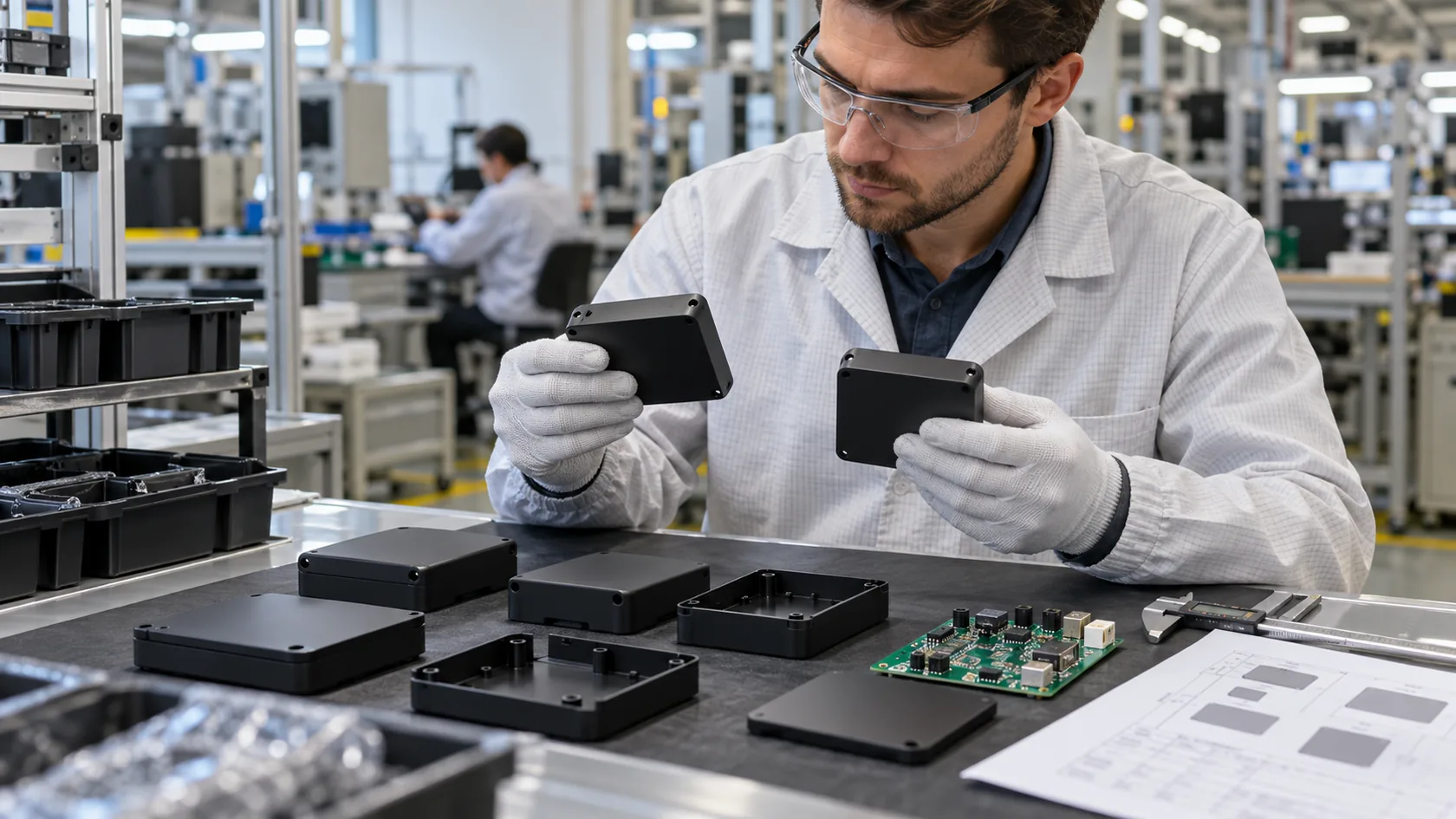
- Raspberry Pi style aluminum cases
- Instrument enclosures
- Front panels
- Heat-dissipation housings
- Consumer electronics shells
For extruded aluminum enclosures, anodizing is often a natural match. Extruded profiles already have a strong aluminum character. Anodizing keeps that character instead of covering it.
For CNC-machined aluminum parts, anodizing can also make the product look more precise and finished. It gives the enclosure a nice touch without hiding the machining quality.
Practical limitations of anodizing
Anodizing is useful, but it is not magic.
The first limitation is color consistency. If the customer needs exact Pantone Black 6C, anodizing may not be the safest choice. Black anodizing can look slightly different depending on aluminum alloy, surface preparation, film thickness, and production batch.
The second limitation is grounding. Anodized surfaces are not naturally good for electrical contact. If the enclosure needs grounding, EMI shielding, or metal-to-metal contact, some areas may need masking or post-machining.
The third limitation is visible surface condition. Anodizing does not hide all scratches, extrusion lines, or material defects. In some cases, it makes them more visible.
Here is how I usually explain it to buyers:
| Need | Is anodizing suitable? | My comment |
|---|---|---|
| Metallic appearance | Yes | One of the best choices |
| Exact Pantone color | Not ideal | Powder coating or painting may be better |
| Strong grounding | Needs planning | Mask contact points |
| Outdoor harsh exposure | Depends | Check environment carefully |
| Hide surface defects | Not good | Surface preparation matters |
| Tight assembly fit | Usually good | Less buildup than thick coating |
Anodizing is a strong option when the customer wants aluminum to still look like aluminum. But if the customer expects perfect color matching, hidden scratches, and automatic grounding at the same time, I slow down the discussion.
That is the moment where a nice finish can become a technical argument.
Powder Coating for Aluminum Enclosures
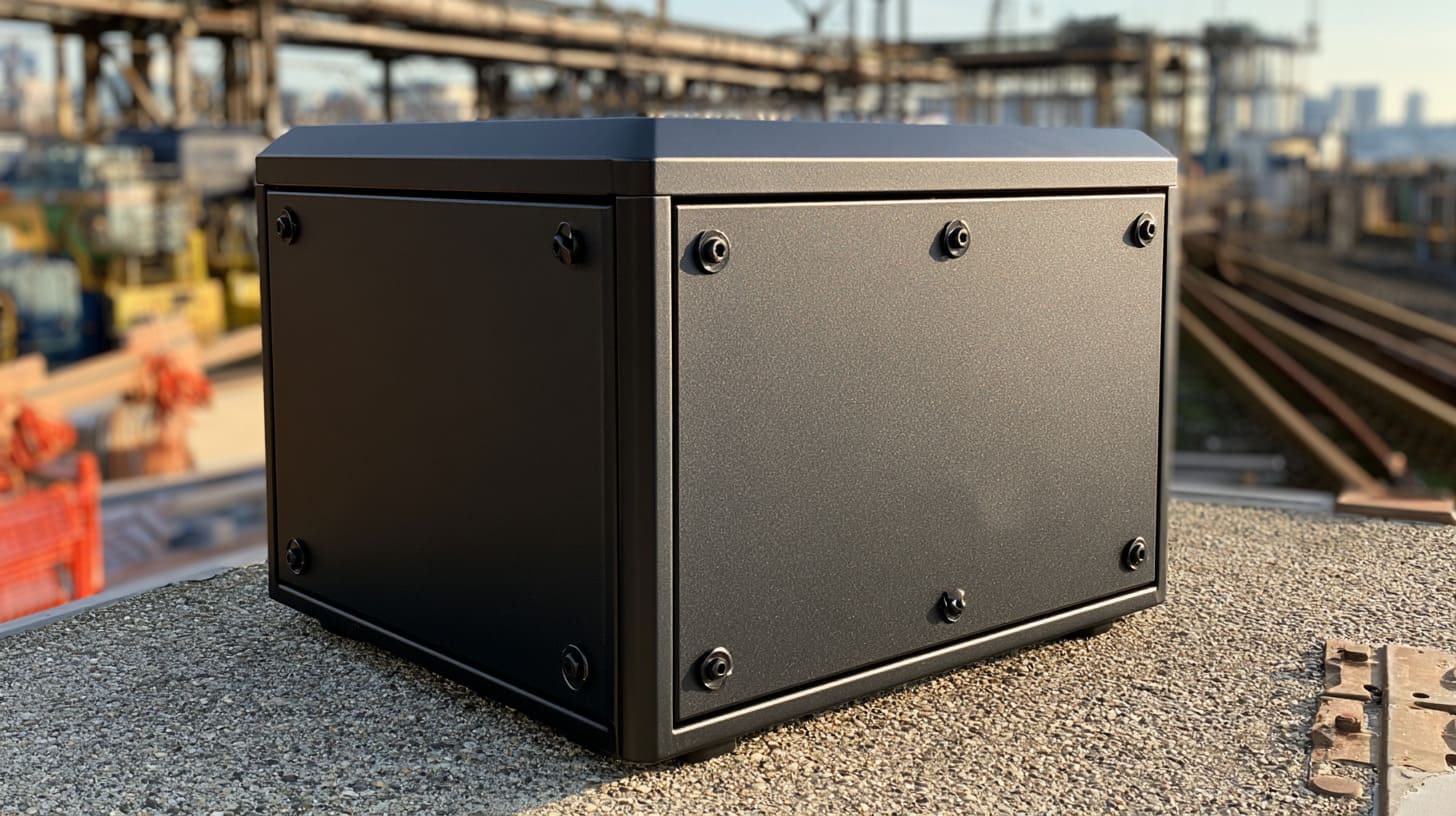
Powder coating is another very common choice for aluminum enclosures. It is popular because it gives strong color coverage, good protection, and many texture options.
When a customer says, “We need matte black,” “We need white housing,” or “We need our brand color,” powder coating often comes into the conversation very quickly.
Powder coating is easy to like. It looks clean. It feels strong. It can make a simple enclosure look more finished.
But I have also seen powder coating create problems when the drawing did not allow for coating thickness.
The small detail I check early is whether the coating will touch any functional surface, because a beautiful powder-coated part can still fail if the cover cannot slide, the screw cannot fit, or the grounding point is covered.
What powder coating does
Powder coating uses dry powder applied to the aluminum surface. The part is then heated, and the powder cures into a protective film.
This film can be smooth, matte, glossy, textured, or rough. It can also be made in many colors.
For custom enclosure projects, powder coating is often selected because it gives customers more visual control. It is especially useful when the product needs to match a brand color or look consistent across different product lines.
Why powder coating is popular
Powder coating is popular for several practical reasons.
| Reason | Why buyers like it |
|---|---|
| Wide color choice | Easier to match product or brand style |
| Strong visual coverage | Hides some surface variation better than anodizing |
| Good protection | Suitable for many industrial applications |
| Texture options | Matte, fine texture, sand texture, glossy finish |
| Suitable for many enclosure types | Sheet metal, die-cast aluminum, custom boxes |
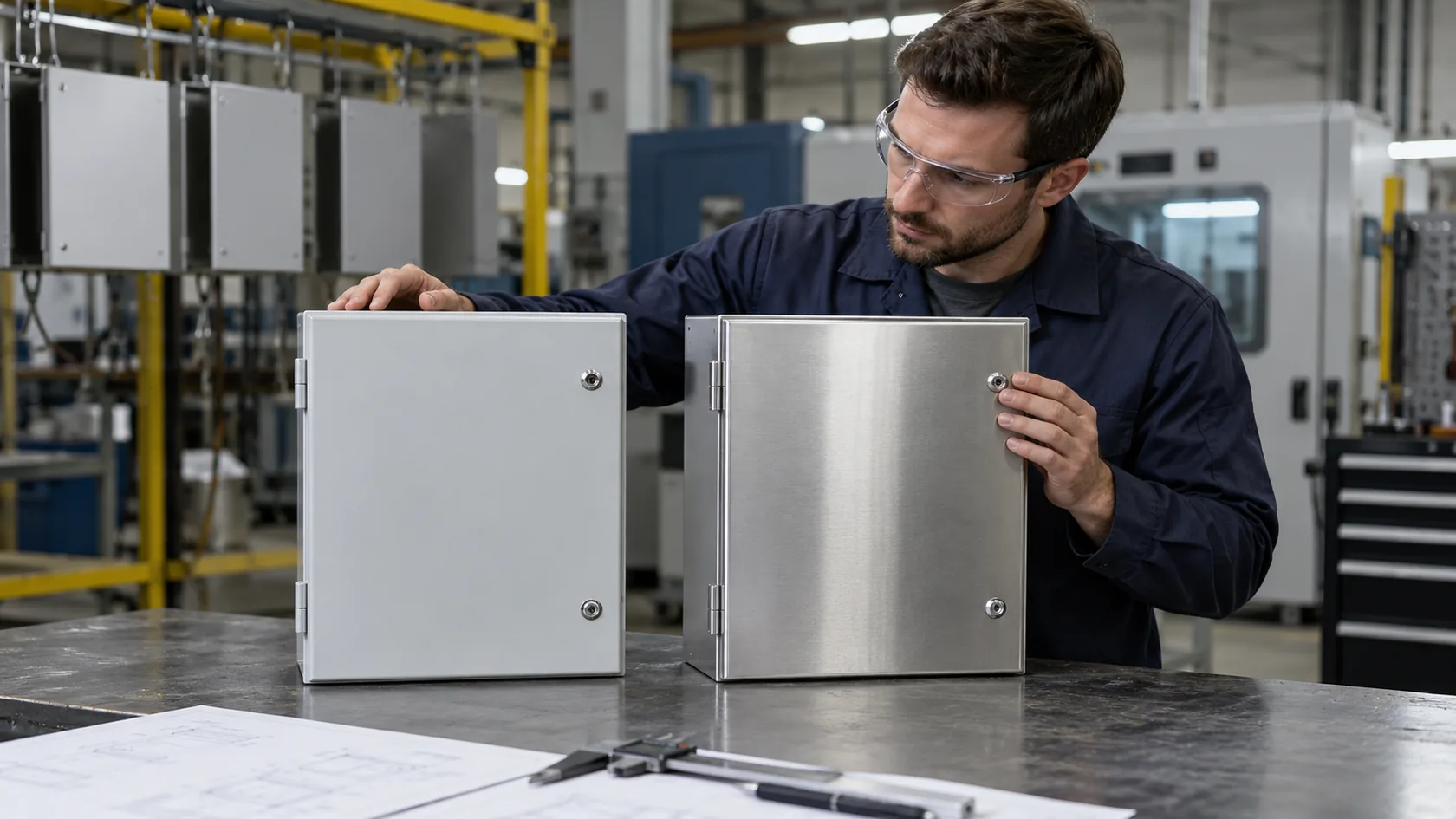
For sheet metal enclosures, powder coating is often the default finish. It covers welded areas, formed edges, and fabrication marks better than anodizing. It also gives the product a complete industrial appearance.
For die-cast aluminum enclosures, powder coating can also help improve appearance because cast surfaces may not look as clean as extruded or CNC-machined surfaces.
Best applications for powder coating
Powder coating is usually a good choice for:
- Outdoor control boxes
- Aluminum junction boxes
- Sheet metal enclosures
- Die-cast aluminum housings
- Custom branded enclosures
- Industrial control cabinets
- Products needing matte or textured surfaces
For example, if a customer wants a black outdoor enclosure for an industrial controller, powder coating can be a very practical option. But I would still ask about the environment. Is it normal outdoor use? Is it coastal? Is there chemical cleaning? Is there strong UV exposure?
The coating system is not only the powder itself. Pretreatment also matters.
If pretreatment is weak, powder coating can peel, bubble, or allow corrosion under the film. The outside may look fine at first, but the problem appears later.
Risks and design details
Powder coating is thicker than many other surface treatments. This is good for protection, but it can affect assembly.
Common problem areas include:
| Area | Possible issue after powder coating |
|---|---|
| Screw holes | Screws may become tight |
| Threads | Threads may need masking or re-tapping |
| Sliding rails | Cover may not slide smoothly |
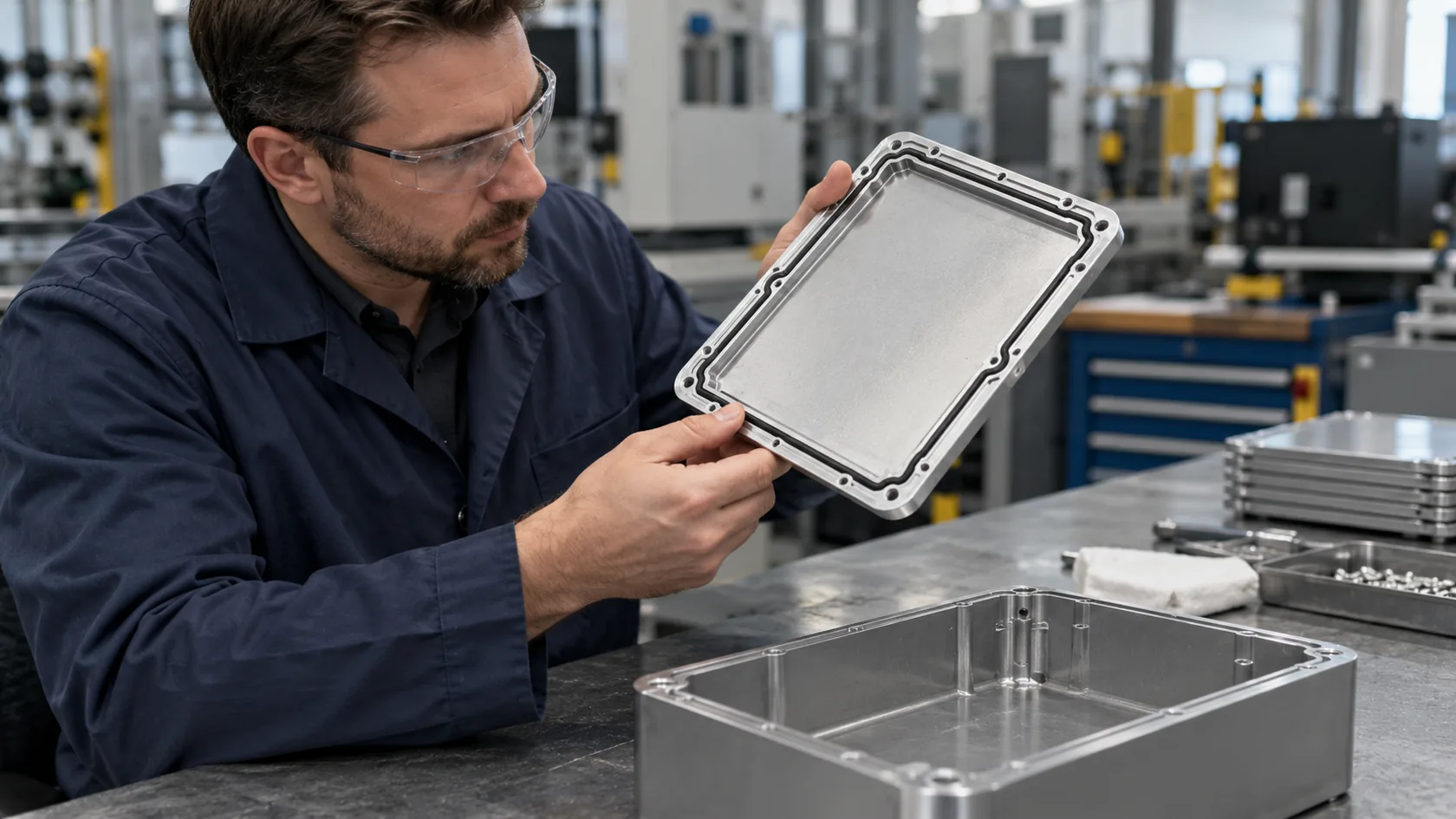
| Gasket grooves | Gasket compression may change |
| Grounding points | Electrical contact may be blocked |
| Tight mating surfaces | Assembly gap may become too small |
| Logo or engraving area | Detail may become less sharp |
This is why coating thickness should be considered in the drawing. If a drawing shows a very tight tolerance, we need to know whether that tolerance is before or after coating.
In some projects, we mask screw holes, grounding points, or sealing surfaces before powder coating. In other projects, we machine or tap some areas after coating. Both methods add cost and need planning.
Powder coating is a strong finish, but it asks for respect. If we treat it like a thin layer of color, it will surprise us later.
And in enclosure manufacturing, surprises are rarely cheap.
Wet Painting and Liquid Coating
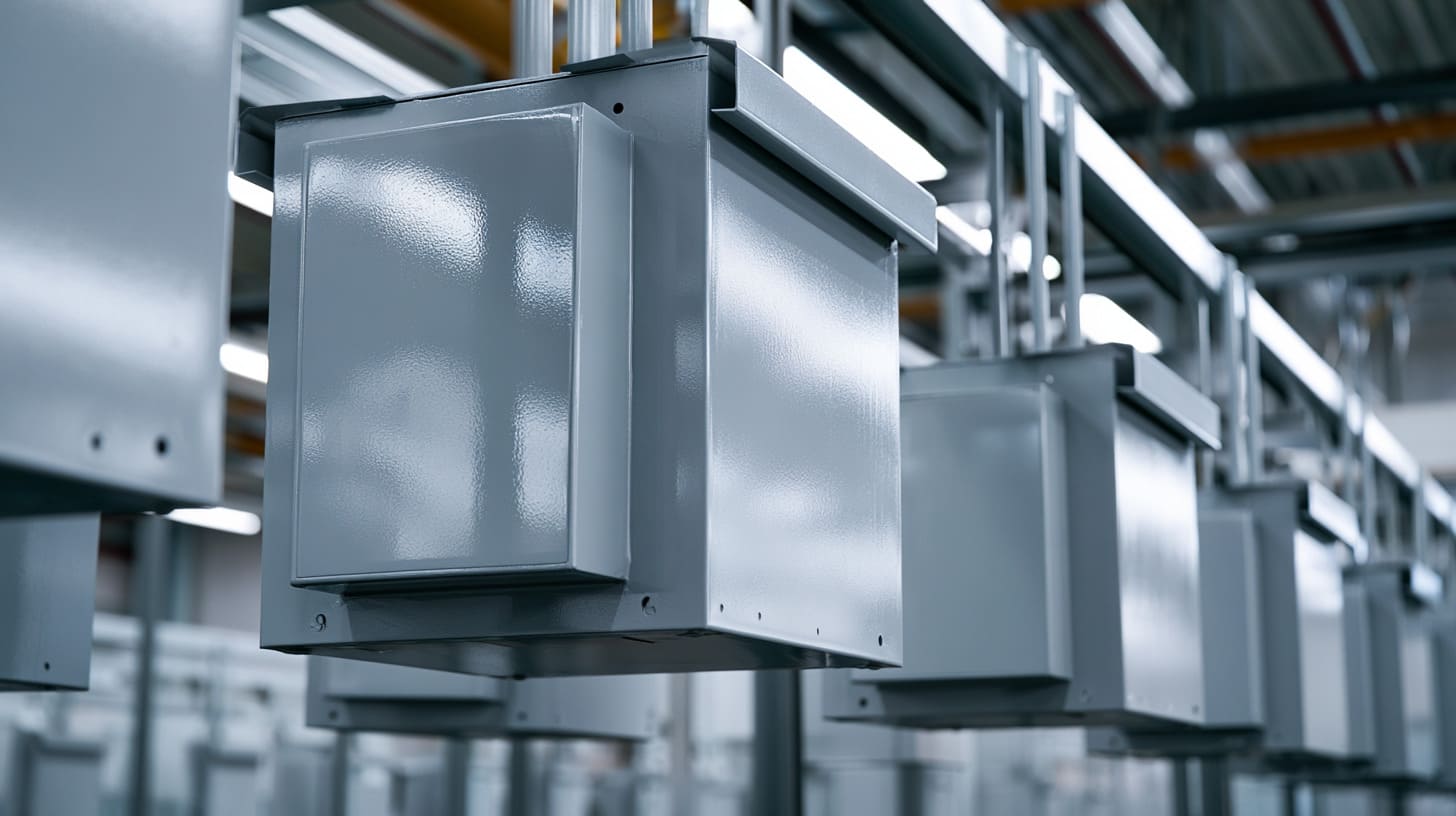
Wet painting, also called liquid coating, is another option for aluminum enclosures. It is not always the first choice for standard industrial housings, but it still has its place.
I usually see wet painting when the customer needs special color control, a smooth cosmetic finish, or a low-volume custom enclosure that does not fit well into powder coating production.
It can look very nice. It can also become expensive if the process is not controlled well.
My main concern with wet painting is repeatability, because a finish that looks perfect on one sample can become difficult when the customer asks for the same color and gloss across many batches.
What wet painting is
Wet painting uses liquid paint sprayed onto the aluminum surface. After spraying, the part cures or dries based on the paint system.
The process sounds simple, but the final result depends on many details:
- Surface cleaning
- Primer selection
- Paint type
- Spraying skill
- Film thickness
- Curing condition
- Dust control
- Color and gloss inspection
Wet painting can give a smooth and clean appearance. It can also support more flexible color matching in some cases.
When wet painting makes sense
Wet painting can make sense in several situations.
| Situation | Why wet painting may work |
|---|---|
| Low-volume custom project | Easier to handle special requests |
| Large enclosure | May be difficult to powder coat depending on equipment |
| Special brand color | Better flexibility for matching |
| High cosmetic requirement | Smooth finish can be controlled carefully |
| Repair or touch-up need | Easier to repair than some other finishes |
If a customer has a small batch of custom aluminum covers and wants a very specific appearance, wet painting may be worth discussing.
For example, a product may need a soft satin finish, a special gray tone, or a surface that matches another plastic part. Powder coating may still work, but wet painting may offer more control in some cosmetic cases.
Comparison with powder coating
Wet painting and powder coating often compete with each other in customer discussions.
Here is a simple comparison:
| Item | Wet painting | Powder coating |
|---|---|---|
| Color matching | Often flexible | Good, but depends on powder availability |
| Durability | Depends on paint system | Usually strong for industrial use |
| Thickness | Can be controlled, but varies | Usually thicker |
| Texture options | Smooth finish is common | Many textures available |
| Small batch | Can be suitable | Sometimes less flexible |
| Environmental control | Needs careful spraying area | Needs curing and powder system |
| Repair | Easier in some cases | Harder to repair invisibly |
I do not say one is always better. I look at the project.
If the enclosure is for a rugged industrial environment, powder coating is often safer. If the enclosure is a small cosmetic part with a special color and low quantity, wet painting may be easier.
Main risks
Wet painting has some risks.
It can be more sensitive to dust, spray angle, curing, and operator skill. If the surface preparation is weak, adhesion may be poor. If the paint film is not controlled well, the finish may show orange peel, uneven gloss, or color difference.
For industrial enclosures, impact resistance may also be lower than powder coating in many cases. This depends on the paint system, but it is still something I check.
Cost is another point. A special paint system may need primer, multiple layers, sanding, curing, and inspection. That can make a small enclosure more expensive than the buyer expected.
I like wet painting when it solves a real visual or production problem. I do not like it when it is chosen only because the customer thinks “paint is easier.”
Easy at the beginning can become difficult at mass production.
Chemical Conversion Coating / Alodine / Chem Film
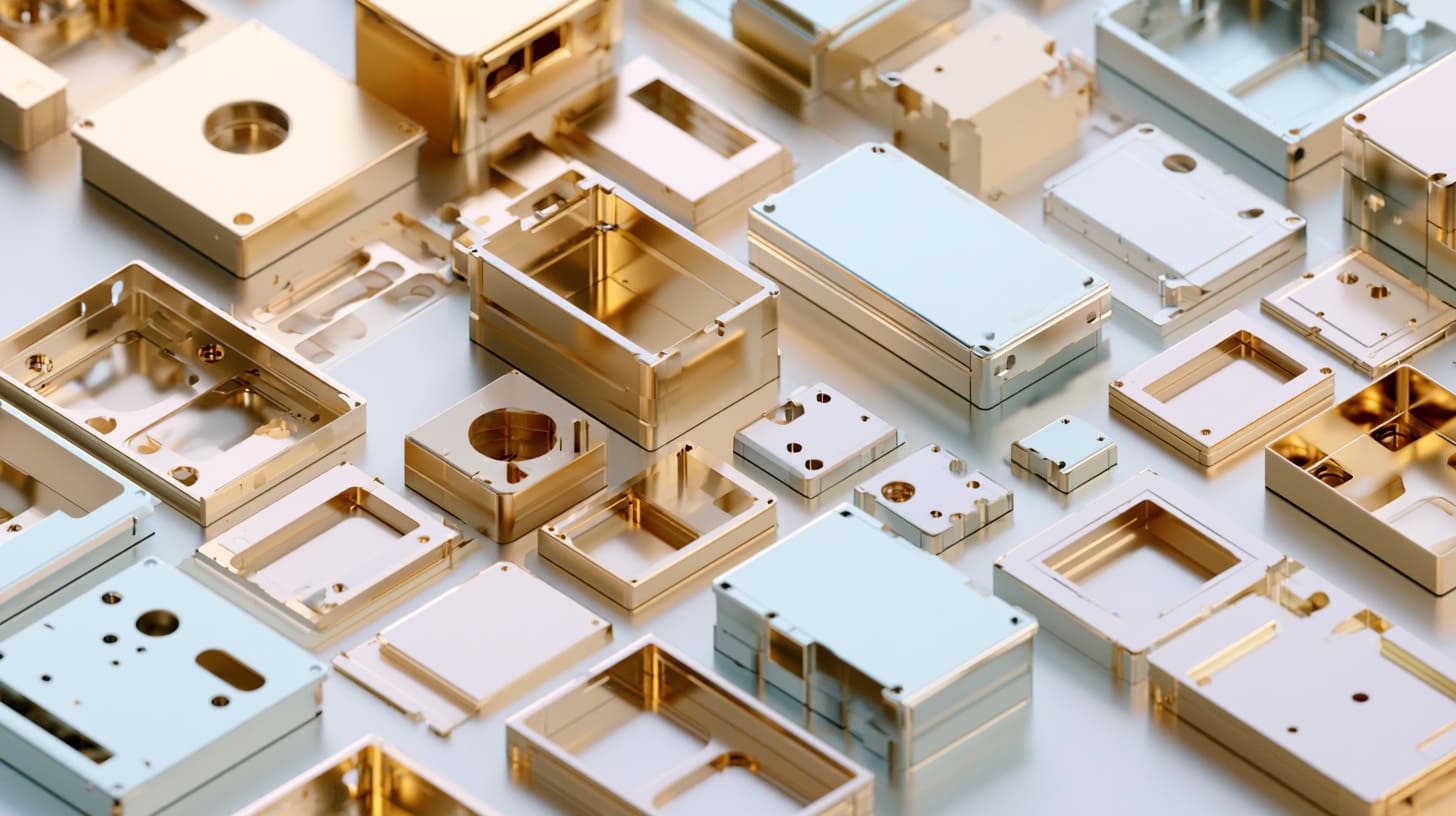
Chemical conversion coating is not as visually attractive as anodizing or powder coating. Many buyers do not ask for it by name unless they already have experience with electronics, aerospace, or EMI-sensitive products.
But for some aluminum enclosures, it is very important.
This finish forms a very thin chemical layer on the aluminum surface. It improves corrosion resistance and keeps better electrical conductivity compared with many non-conductive finishes.
When I see an enclosure with EMI, grounding, or tight tolerance needs, chem film moves much higher on my list.
The choice here is not about beauty first; I care more about whether the enclosure can keep electrical contact without adding too much thickness.
What chemical conversion coating does
Chemical conversion coating reacts with the aluminum surface and forms a thin protective layer. It is much thinner than powder coating. It also does not give the same strong cosmetic finish.
Some buyers know it as Alodine or chem film. These names are often used in engineering drawings.
The main benefits are:
- Thin surface layer
- Better corrosion resistance than raw aluminum
- Better conductivity than anodizing or powder coating
- Useful before painting or powder coating
- Good for areas with tight dimensional control
Because it is thin, it is helpful for precision parts where coating buildup is a concern.
Why it matters for electronic enclosures
Electronic enclosures often need more than appearance.
They may need:
- Grounding
- EMI shielding
- Conductive internal surfaces
- Stable contact between panels
- Electrical bonding between parts
- Controlled thickness around assembly areas
If the whole enclosure is powder coated, the coating may block electrical contact. This can cause grounding problems. It can also affect EMI performance.
Chem film is useful because it can protect the aluminum while keeping a conductive surface.
For an aluminum electronics housing, this can be more important than many buyers expect.
Common use cases
Chemical conversion coating is often used in:
| Use case | Why it helps |
|---|---|
| Internal aluminum surfaces | Keeps conductivity |
| EMI-sensitive enclosures | Supports shielding and grounding |
| Aerospace or industrial housings | Functional surface protection |
| Parts before painting | Improves coating base |
| Tight tolerance areas | Adds very little thickness |
| Grounding contact zones | Allows better metal contact |
One common hybrid solution is powder coating outside and chem film inside. The outside gets color and protection. The inside keeps better conductivity.
Another option is anodizing or powder coating with masked contact areas. But if many internal surfaces need conductivity, chem film may be more practical.
Important limitations
Chem film is not a decorative finish. It may look yellowish, clear, or uneven depending on the process. It will not give the deep black look of anodizing or the strong color coverage of powder coating.
It also may not be enough for harsh outdoor exposure by itself. If the enclosure faces rain, salt, UV, or chemicals, we need to check whether another coating system is needed.
Another important point is compliance. Some older conversion coatings used hexavalent chromium. Many projects now need RoHS-friendly or trivalent options. If the enclosure is exported to Europe or used in strict industries, this must be checked before production.
I never treat chem film as a normal cosmetic finish. I treat it as a functional decision.
It is quiet. It is thin. It does not show off. But in the right project, it solves problems that a beautiful coating cannot solve.
Electrophoretic Coating / E-Coating
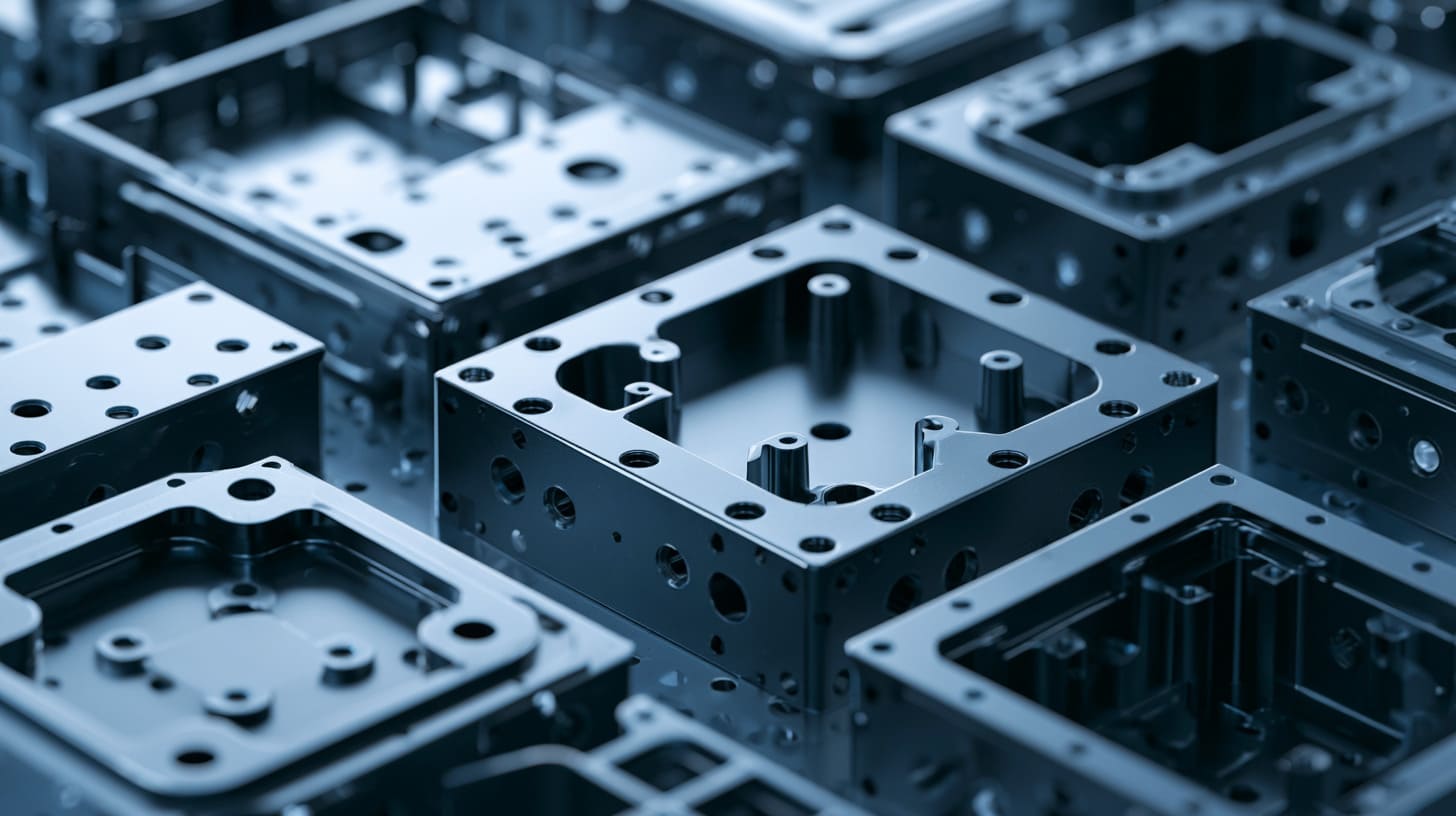
E-coating is not the most common finish for small custom aluminum enclosure projects, but it is still worth understanding.
Electrophoretic coating uses an electrical process to deposit paint onto the part. The advantage is uniform coverage. It can reach corners and recessed areas better than normal manual spraying.
For complex parts, this can be useful.
I start to consider e-coating when the shape is difficult to cover evenly, but I also check order quantity because the setup cost may not make sense for a small custom batch.
What e-coating is
E-coating deposits paint through an electrical process. The part is placed in a coating bath, and electricity helps the coating attach to the surface.
This process can create a thin, even protective layer. It is common in some industrial and automotive applications.
For enclosures, the main idea is simple: if the part has complex geometry, e-coating can help create more even coverage than manual spraying.
Where e-coating is useful
E-coating may be useful for:
- Parts with deep corners
- Enclosures with complex internal shapes
- Products needing consistent internal and external coverage
- Parts that need a thin and even protective layer
- Components used as a primer base before another finish
For simple extruded aluminum cases, e-coating is often not needed. Anodizing or powder coating may be easier.
For complex housings, especially if internal coverage matters, e-coating can become more interesting.
Advantages for enclosure projects
The main advantage is coverage.
Manual spraying may miss corners, inner edges, and recessed areas. Powder coating also has some limitations in deep areas due to electrostatic behavior. E-coating can offer more uniform coverage in these locations.
Here is a quick comparison:
| Feature | E-coating | Manual wet painting | Powder coating |
|---|---|---|---|
| Internal corner coverage | Good | Depends on operator | May be limited in deep areas |
| Thickness uniformity | Good | Variable | Good, but shape-sensitive |
| Color options | More limited | Flexible | Wide |
| Small batch flexibility | Not always ideal | Better | Medium |
| Decorative texture | Limited | Good | Very good |
This is why e-coating is often selected for function and coverage, not for wide decorative choices.
Limitations to consider
E-coating has limits.
It may not be suitable for very small custom orders because the process needs proper setup. Color and texture choices may also be limited compared with powder coating.
Some customers may ask for a special matte finish, exact color, or branded surface. In that case, e-coating alone may not be enough.
It can also be used as a primer before another coating, but that adds process steps and cost.
For MaidaTech-style custom enclosure projects, I would not make e-coating the default choice. I would use it only when the enclosure shape or coverage requirement gives a clear reason.
A coating process should earn its place in the project. If it only adds complexity without solving a real problem, I would rather keep the finish simpler.
Plating Options for Aluminum Enclosures
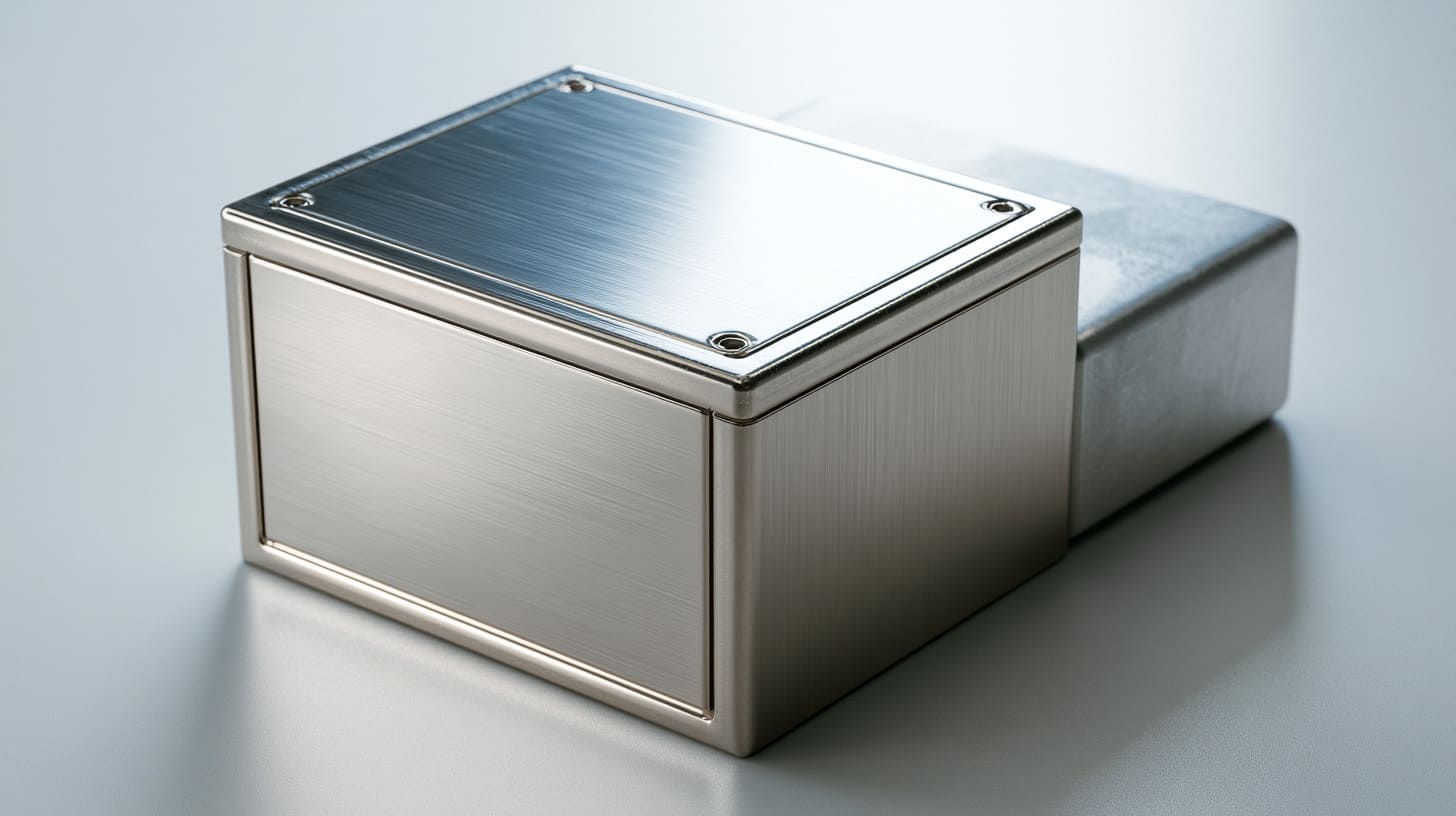
Plating is less common for standard aluminum enclosures, but it still appears in special projects.
Aluminum is not as easy to plate as some other metals. It needs proper pretreatment. If the process is not controlled well, adhesion can become a serious problem.
So when a customer asks for plating on aluminum, I do not treat it like normal powder coating. I ask more questions first.
Before I quote plating, I want to know whether the customer needs wear resistance, conductivity, corrosion resistance, or only a shiny appearance, because plating for decoration and plating for function are two very different discussions.
Why plating is less common but still useful
Most aluminum enclosures do not need plating. Anodizing, powder coating, or chem film usually covers the common needs.
Plating becomes useful when the project has more specific requirements, such as:
- Higher wear resistance
- Better surface hardness
- Special conductivity
- Special corrosion protection
- Decorative metallic appearance
- Functional contact surface
But the cost is usually higher. The process is also more sensitive.
This is why plating is not usually the first recommendation for a normal aluminum housing.
Electroless nickel plating
Electroless nickel plating is one of the more useful plating options for aluminum parts.
It can provide a harder and more uniform metallic layer. It can improve wear resistance and corrosion resistance. It can also cover complex shapes more evenly than some other plating methods.
Common use cases may include:
- Functional aluminum parts
- Special industrial housings
- Wear surfaces
- Precision components
- Parts needing a harder metallic surface
- Demanding environments
For enclosure projects, I usually see electroless nickel when the part is not just a box. It may have mechanical contact surfaces, sliding areas, or special industrial requirements.
Nickel, chrome, or other decorative plating
Nickel, chrome, and other decorative plating options can improve appearance and surface hardness.
But I do not often recommend them for standard aluminum enclosures unless the design really needs that look or function. The cost can be higher. The process can be more complicated. And poor adhesion can cause big quality issues.
If the project only needs a black or gray enclosure, powder coating or anodizing is usually more practical.
If the project needs a metallic decorative surface, plating may be discussed, but samples become very important.
Practical concerns
Plating can change dimensions. It can also affect holes, grooves, and mating areas.
Like other coatings, plating must be considered in the drawing. If the customer has tight tolerance requirements, we need to confirm whether the final dimension is before or after plating.
Important checks include:
| Check point | Why it matters |
|---|---|
| Aluminum alloy | Some alloys are harder to plate well |
| Pretreatment process | Poor pretreatment causes adhesion failure |
| Plating thickness | Affects dimensions and fit |
| Function of plated area | Determines process choice |
| Sample approval | Confirms appearance and adhesion |
| Cost target | Plating may be much more expensive |
Plating can solve special problems. But it is not a casual finish.
I think of it like using a special tool. It is powerful when needed. But if the job only needs a screwdriver, I do not bring a complicated machine.
Brushing, Polishing, and Mechanical Surface Finishes
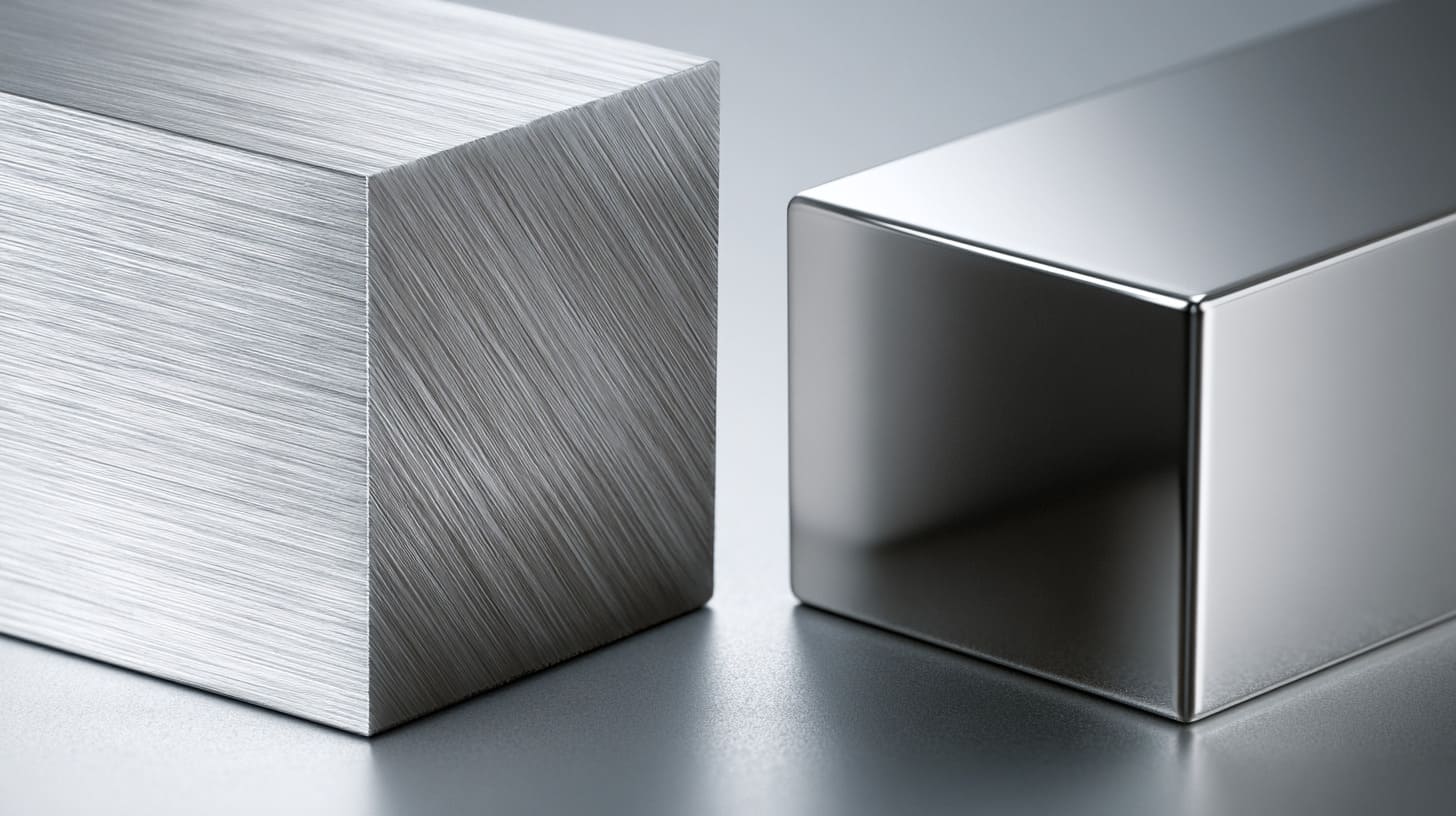
Brushing and polishing are different from chemical coatings. They mainly change the surface texture. They make the enclosure look more refined, but they do not always provide strong protection by themselves.
These finishes are common for front panels, faceplates, premium electronics housings, and products where the first visual impression matters.
I pay close attention to the raw surface before brushing or polishing, because mechanical finishing can improve the look, but it cannot magically remove every extrusion line, dent, or deep scratch.
What mechanical finishes do
Mechanical finishes physically change the aluminum surface.
Brushing creates fine directional lines. Polishing makes the surface brighter and smoother. Sandblasting can create a matte texture. These processes can be used alone or before anodizing.
For aluminum enclosures, brushing plus anodizing is very common. It gives the product a clean industrial feel.
Mechanical finishing is often about feel and appearance. When a customer holds the enclosure, the surface can make the product feel more expensive or more professional.
Brushed aluminum finish
Brushed aluminum has a directional grain. It looks neat and controlled.
It is common for:
- Front panels
- Audio equipment housings
- Instrument panels
- Consumer electronics
- Custom aluminum faceplates
- Premium project enclosures
Brushing can make the part look more refined. But it also creates direction. This means all parts need consistent brushing direction. If one cover is brushed horizontally and another is brushed vertically, the product can look messy.
For branded products, this small detail matters a lot.
| Detail | Why it matters |
|---|---|
| Brush direction | Affects visual consistency |
| Surface flatness | Uneven surfaces show more clearly |
| Edge condition | Sharp or rough edges reduce quality feel |
| Anodizing after brushing | Can improve protection and appearance |
| Handling marks | Need careful packaging and protection |
Polished aluminum finish
Polished aluminum creates a brighter surface. It can look very clean when new.
But polished surfaces can also show fingerprints, scratches, and handling marks more easily. For industrial enclosures, this may not be practical. For decorative or display products, it may still be useful.
I usually ask customers how the product will be used. Will people touch it every day? Will it be packed, shipped, and handled many times? Will scratches become a complaint?
A finish that looks good in a sample photo may not be the best finish after real use.
Key decision point
Mechanical finish should be confirmed before anodizing or coating. If the customer wants brushed plus clear anodizing, we must plan the brushing before anodizing.
If the part has deep scratches, extrusion lines, welding marks, or uneven surfaces, mechanical finishing may not hide everything. Sometimes it can make defects more visible.
Here is a simple decision table:
| Customer need | Possible finish |
|---|---|
| Clean metallic look | Brushing + clear anodizing |
| Premium black aluminum look | Brushing + black anodizing |
| Bright decorative look | Polishing |
| Matte texture | Sandblasting + anodizing |
| Strong color coverage | Powder coating instead |
Mechanical finishing is about more than beauty. It controls how the product feels in the customer’s hand.
And in many markets, the customer judges quality before they even turn the product on.
Hybrid Coating Strategies for Custom Aluminum Enclosures
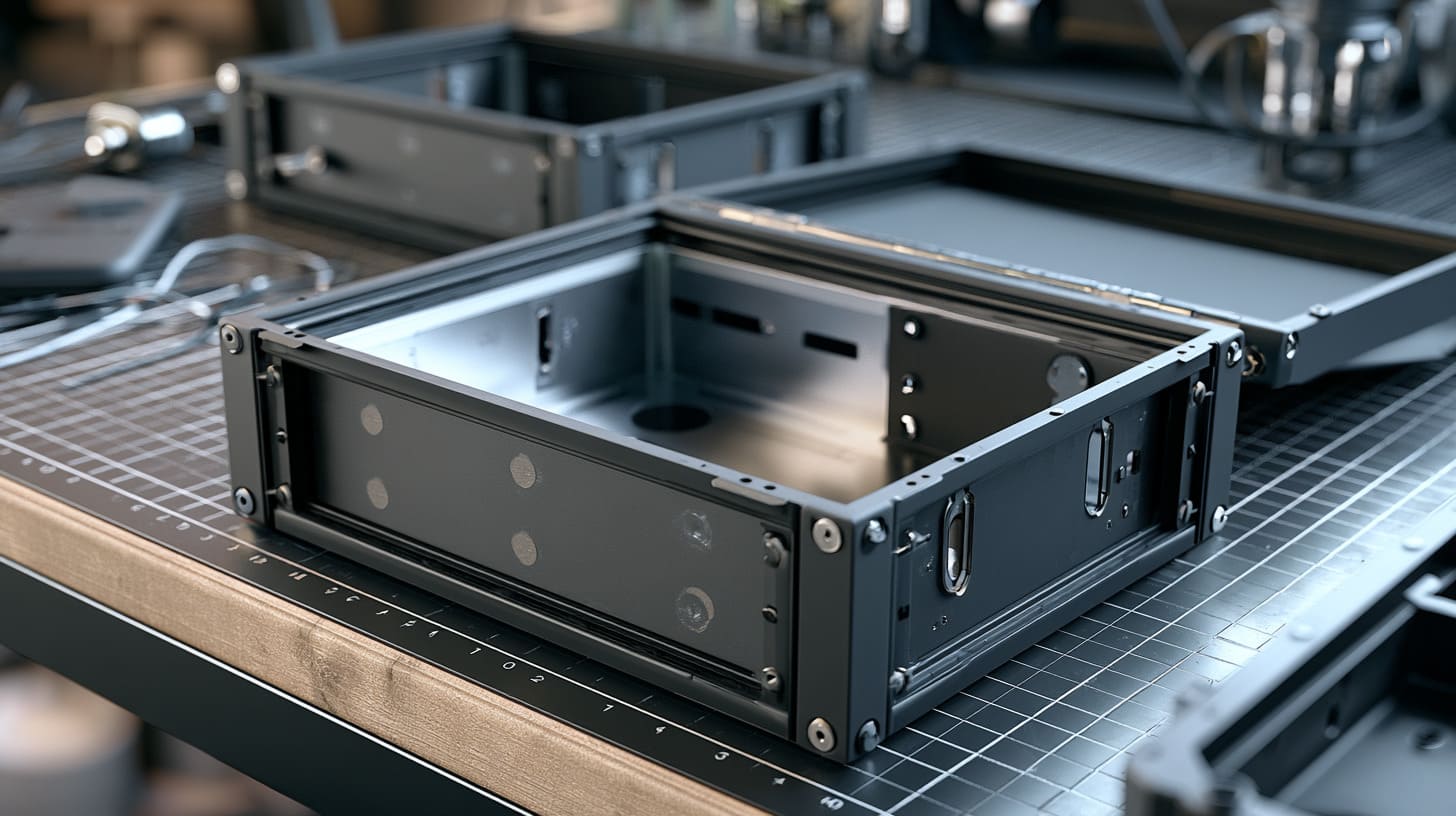
In many custom enclosure projects, one coating is not enough.
The outside may need color. The inside may need conductivity. The gasket area may need controlled compression. The grounding screw may need bare metal contact. The thermal pad area may need direct metal contact.
This is where hybrid coating strategy becomes important.
I become careful when a drawing says “full coating” too easily, because full coating sounds clean on paper, but real enclosures often need different surface rules in different areas.
Why one coating is not always enough
An enclosure is not just a shell. It often has several jobs.
It protects electronics. It supports assembly. It may help heat transfer. It may help EMI shielding. It may carry a brand logo. It may also need to survive rain, dust, UV, or chemical exposure.
One coating cannot always serve all these jobs.
For example, powder coating outside is good for color and protection. But if the inside also needs grounding, full powder coating may create problems. Anodizing gives a nice metallic look, but it may not match an exact Pantone color. Chem film keeps conductivity, but it does not give a premium cosmetic surface.
So the better answer may be a mixed approach.
Common hybrid solutions
Here are common hybrid strategies I see in aluminum enclosure projects:
| Hybrid solution | Why it is used |
|---|---|
| Powder coating outside, masked conductive points inside | Color outside, grounding inside |
| Chem film inside, powder coating outside | EMI and appearance both considered |
| Anodized exterior, bare grounding points | Metallic look with electrical contact |
| Brushed finish plus clear anodizing | Better cosmetic surface with protection |
| Powder coating plus masked gasket groove | Better sealing control |
| Coated housing with post-machined contact areas | Clean appearance with functional surfaces |
These solutions are not complicated in theory. But they must be clear in the drawing.
If the drawing does not mark masked areas, the factory may coat everything. Then the buyer may receive parts that look correct but fail during assembly or electrical testing.
When hybrid coating is necessary
Hybrid coating is often needed for:
- EMI-sensitive devices
- Outdoor communication equipment
- Industrial control boxes
- Power electronics housings
- Enclosures with grounding screws
- Cases with thermal pads
- Products with gasket sealing
- Sliding extruded aluminum covers
- Custom branded electronic enclosures
For example, in a communication device, the customer may want a black outside finish. But the inside surface may need conductivity for EMI shielding. In that case, we may suggest powder coating outside and chem film or masked bare aluminum inside.
For a heat-dissipation enclosure, the outside finish may be fine, but the thermal contact area should not be covered with thick powder coating.
Cost and production impact
Hybrid coating adds cost. It also adds time.
Masking needs labor. Multiple processes need scheduling. Inspection becomes more detailed. The packing team must also protect finished surfaces carefully.
Here is where buyers sometimes get surprised.
| Requirement | Production impact |
|---|---|
| Masking screw holes | More labor |
| Masking grounding points | More inspection |
| Powder outside + chem film inside | More process steps |
| Post-machining after coating | Higher cost and risk |
| Multiple surface finishes | Longer lead time |
| Exact cosmetic requirements | More sample checks |
Hybrid coating is often the right choice, but it should be used with clear purpose.
I do not add complexity to make a project look fancy. I add it when the product needs it to work correctly.
That is the difference between decoration and engineering.
How Coatings Affect Enclosure Design
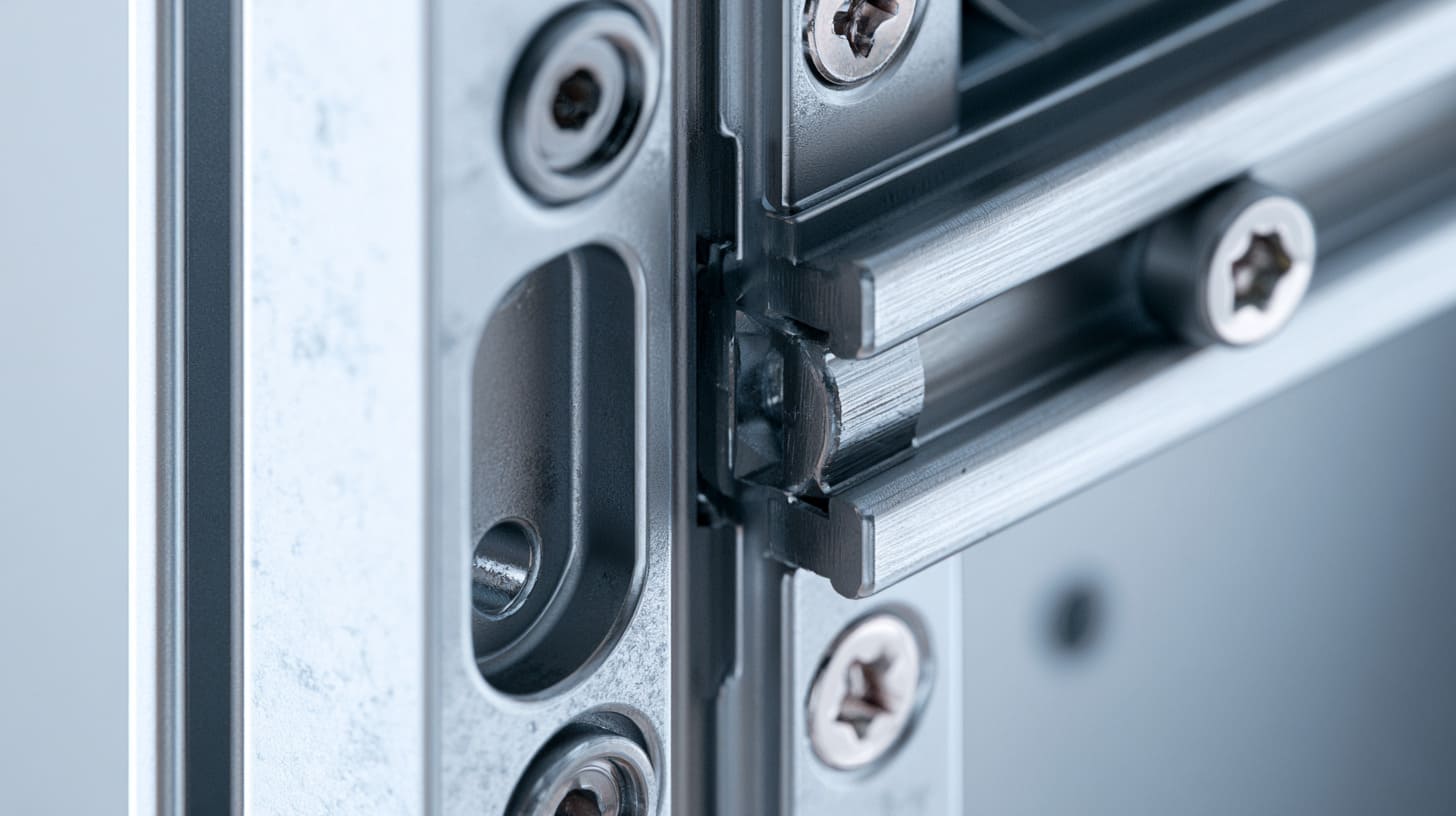
Coating affects enclosure design more than many buyers expect.
A drawing may look perfect before finishing. Then the coating comes, and small problems appear. A screw becomes tight. A sliding cover feels stuck. A gasket does not compress evenly. A grounding point does not conduct. A thermal pad does not contact the metal well.
These are not big design mistakes on paper. They are small details. But small details are where enclosure projects often fail.
When I review a coating request, I do not only ask what finish the customer wants; I check where that finish may interfere with the enclosure’s real job.
Coating thickness and tolerance
Coating thickness matters.
Powder coating adds more thickness than chem film. Wet painting also adds a film. Anodizing changes the aluminum surface and may slightly affect dimensions. Plating can add measurable thickness as well.
The key question is simple: does the drawing tolerance refer to the raw part or the finished part?
If this is not clear, both sides may think they are correct.
| Surface process | Thickness concern | Design attention |
|---|---|---|
| Powder coating | Higher buildup | Holes, grooves, rails, threads |
| Wet painting | Variable film thickness | Cosmetic areas, fit areas |
| Anodizing | Smaller dimensional change | Precision surfaces, color consistency |
| Chem film | Very thin | Good for tight tolerance areas |
| Plating | Can affect dimensions | Functional surfaces, holes |
Tight slots, screw holes, grooves, and mating surfaces should allow for coating buildup. If they do not, the product may require rework.
Grounding and EMI shielding
Many coatings are not conductive. Powder coating and wet painting can block electrical contact. Anodizing also reduces conductivity on the surface.
This matters for electronic enclosures.
If the enclosure is part of the grounding path, coating can break that path. If the enclosure helps with EMI shielding, coated joints may reduce performance.
Common solutions include:
- Masking grounding points
- Using conductive gaskets
- Applying chem film to internal surfaces
- Post-machining contact areas
- Adding grounding screws with bare metal contact
- Clearly marking conductive zones on drawings
I often ask customers whether the enclosure is only mechanical or also electrical. If it has an electrical function, the coating choice needs much more care.
Heat dissipation
Aluminum is often selected because it conducts heat well. But the coating can affect how heat moves through the product.
This is especially important for fanless devices, outdoor electronics, LED housings, power modules, and industrial controllers.
If a PCB uses a thermal pad to transfer heat to the enclosure, the contact surface should be checked carefully. A thick coating may reduce direct metal-to-metal contact. It may also change the contact pressure.
Possible solutions include:
| Heat-related area | Possible treatment |
|---|---|
| Thermal pad contact area | Mask coating or machine after coating |
| External heatsink fins | Anodizing or controlled coating |
| Internal heat transfer surface | Keep flat and clean |
| High-power module contact | Confirm surface roughness and coating rule |
| Outdoor heat-dissipation case | Balance IP sealing and thermal design |
Heat problems are sometimes blamed on the PCB or product design. But the enclosure surface can also play a role.
Gasket sealing and assembly fit
If the enclosure needs an IP rating, gasket design becomes important.
Coating buildup on gasket grooves can affect compression. If the groove becomes too shallow or uneven, the gasket may not seal properly. If screw holes are coated too thick, the cover may not tighten evenly.
For extruded aluminum enclosures, sliding covers and rails also need enough clearance. Powder coating can make the sliding fit too tight.
Assembly fit is not only about machining. It is also about finishing.
That is why I like to check coating at the design stage, not after the first batch has already failed.
How to Choose the Right Surface Coating for Your Aluminum Enclosure
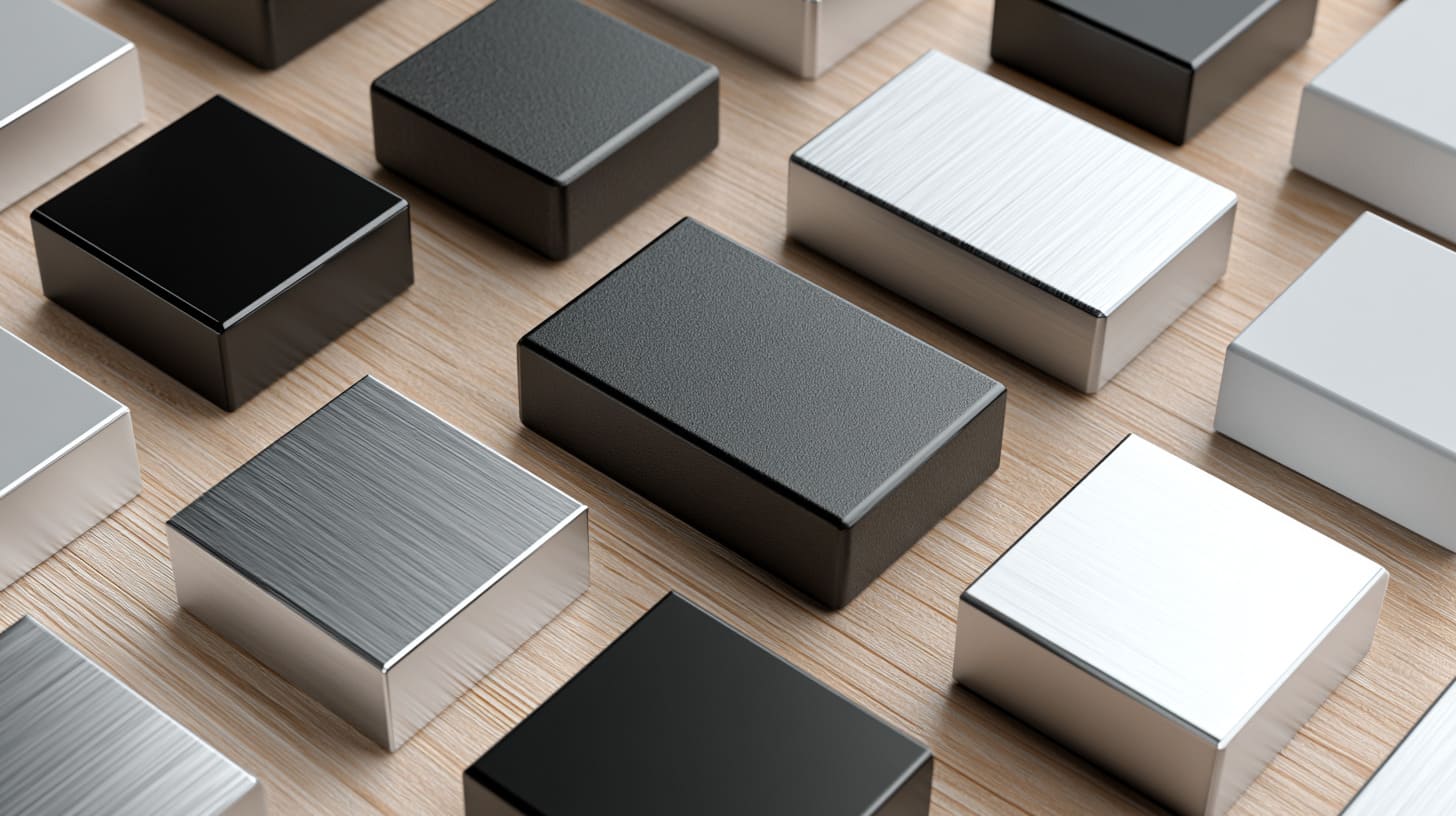
Choosing the right surface coating is not about finding the “best” finish. It is about finding the right match.
A beautiful black anodized enclosure may be wrong for exact brand color. A strong powder coating may be wrong for tight sliding parts. A thin chem film may be right for EMI but wrong for appearance. Wet painting may be useful for color control but may not be the best for rugged industrial use.
So I usually do not answer coating questions with one word.
My decision starts from the product’s real use, because the same aluminum enclosure can need a very different finish when it moves from a clean office to a coastal outdoor site.
For indoor electronic enclosures
For indoor electronic enclosures, the environment is usually less aggressive. The surface finish can focus more on appearance, light protection, and assembly function.
Common choices include:
| Need | Suggested finish |
|---|---|
| Clean aluminum look | Clear anodizing |
| Black industrial look | Black anodizing |
| Brand color | Powder coating or painting |
| Grounding or conductivity | Chem film or masked areas |
| Low cosmetic requirement | Simple anodizing or basic coating |
Indoor products still need careful design. Fingerprints, scratches, and assembly marks can still hurt the customer’s impression.
If the product is sold on Amazon, through distributors, or under the customer’s brand, appearance matters more. In that case, sample approval is important.
For outdoor aluminum enclosures
Outdoor aluminum enclosures need more protection.
Rain, UV, humidity, dust, and temperature changes can all affect the surface. In coastal areas, salt can make the situation harder.
Powder coating with proper pretreatment is often used for outdoor applications. But not all powder coating systems are equal. Pretreatment, powder type, film thickness, and process control matter.
For outdoor use, I usually ask:
- Is it under shelter or fully exposed?
- Is the location near the sea?
- Will it face strong sunlight?
- Is there chemical cleaning?
- What IP rating is required?
- Is color fading acceptable?
- Is salt spray testing required?
For normal outdoor use, powder coating may be enough. For harsh environments, we may need stronger corrosion planning.
For EMI-sensitive devices
For EMI-sensitive devices, the coating choice must support electrical function.
A fully coated enclosure may look perfect but perform poorly if it blocks contact between panels. In this case, the design may need conductive areas, masking, chem film, or conductive gaskets.
| EMI requirement | Coating strategy |
|---|---|
| Basic grounding | Mask grounding points |
| Stronger EMI shielding | Conductive internal surfaces |
| Painted exterior | Keep internal contact zones conductive |
| Anodized housing | Add bare contact points |
| Multi-part enclosure | Control contact between covers and body |
If the customer does not tell us about EMI early, we may quote the wrong finish. Later, the product may fail testing, and everyone becomes nervous.
This is why I ask electrical questions even when the RFQ looks mechanical.
For cosmetic branded products
For branded products, appearance becomes very important.
Customers may care about:
- Exact color
- Gloss level
- Texture
- Logo quality
- Touch feeling
- Batch consistency
- Scratch resistance
- Packaging protection
Powder coating and wet painting are usually better for custom color matching. Anodizing is better for metallic appearance, but it is not always good for exact brand colors.
If the customer wants a brand color, I prefer to confirm a color code, sample, or physical reference. Photos are not enough. Screen colors can mislead both sides.
For logo work, coating also matters. Laser engraving, silk printing, UV printing, and pad printing may perform differently on different finishes.
For high-precision machined enclosures
High-precision machined enclosures need special care.
If the part has tight tolerance, sliding assembly, precision grooves, or fine threaded holes, thick coating may create problems.
In these cases, anodizing or chem film may be better than powder coating. If powder coating is required, masked areas may be necessary.
Important drawing notes include:
- Coating type
- Coating thickness
- Critical dimensions before or after finishing
- Masked areas
- Thread treatment
- Contact surfaces
- Cosmetic surface grade
A good coating decision protects the product. A careless one creates rework.
And rework is one of the most expensive words in custom manufacturing.
Common Mistakes When Specifying Aluminum Enclosure Coatings
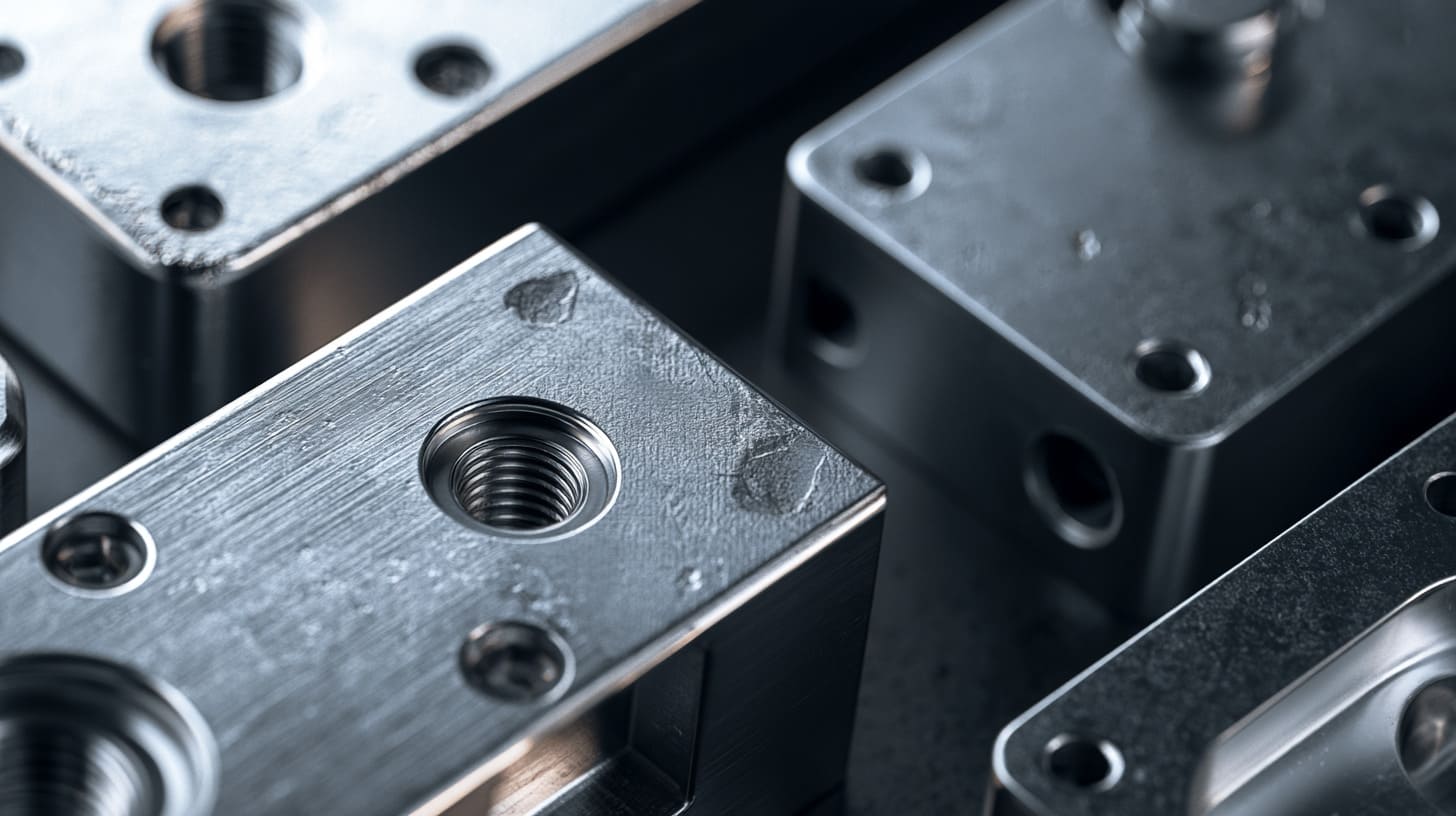
Most coating problems do not happen because the buyer is careless. They happen because the coating looks like a small detail at the beginning.
The drawing is already hard enough. The PCB is not finished. The deadline is close. The customer wants quotation quickly. So someone writes “black powder coating” or “anodized finish” and moves on.
That is understandable. But it can be risky.
The mistake I see most often is choosing a finish before the product environment is clear, because the coating then becomes a guess instead of a decision.
Choosing coating before defining the environment
A coating that works indoors may fail outdoors. A finish that works in dry air may not work near the sea. A coating that works for a normal factory may not survive chemical cleaning.
Before coating selection, the environment should be clear.
| Environment detail | Why it matters |
|---|---|
| Indoor or outdoor | Changes corrosion and UV needs |
| Coastal or normal location | Salt spray risk |
| High humidity | Corrosion and condensation risk |
| Chemical exposure | Coating resistance needed |
| Direct sunlight | UV and fading risk |
| Cleaning method | Washdown or chemical resistance |
| Temperature range | Expansion and durability |
If the customer cannot provide all details, we can still make a reasonable suggestion. But we should know that some risk remains.
Ignoring coating thickness
This is a very common issue.
A part may fit perfectly before coating. After powder coating, the cover becomes tight. The screw hole becomes smaller. The rail does not slide. The gasket groove changes.
This is not always a machining problem. It is often a finishing allowance problem.
The drawing should clearly show critical areas. Some areas may need masking. Some threads may need tapping after coating.
Forgetting grounding and conductive areas
A coating can make the enclosure look better and perform worse at the same time.
This happens when grounding points are covered. It also happens when EMI contact areas are coated.
If the enclosure is only a plastic-like shell, this may not matter. But aluminum enclosures are often selected partly because they can help with shielding, grounding, and heat.
So the surface must support the reason why aluminum was selected in the first place.
Treating all aluminum alloys the same
Different aluminum alloys behave differently during finishing.
Extruded aluminum, cast aluminum, sheet aluminum, and CNC-machined aluminum may not show the same result after anodizing or coating.
For example, anodizing color can vary between alloys. Die-cast aluminum may need different pretreatment. Sheet metal may show bending or surface marks if cosmetic standards are high.
This is why sample confirmation is important when appearance matters.
Skipping samples
Samples are not just for checking size. They are also for checking finish.
A sample can show:
- Color
- Gloss
- Texture
- Coating thickness effect
- Logo quality
- Scratch resistance
- Assembly fit
- Gasket compression
- Grounding contact
For custom OEM enclosure projects, I like samples because they reduce arguments later.
A sample may feel slow at the beginning, but it often saves time before mass production.
What Information Should Buyers Provide Before Quotation?
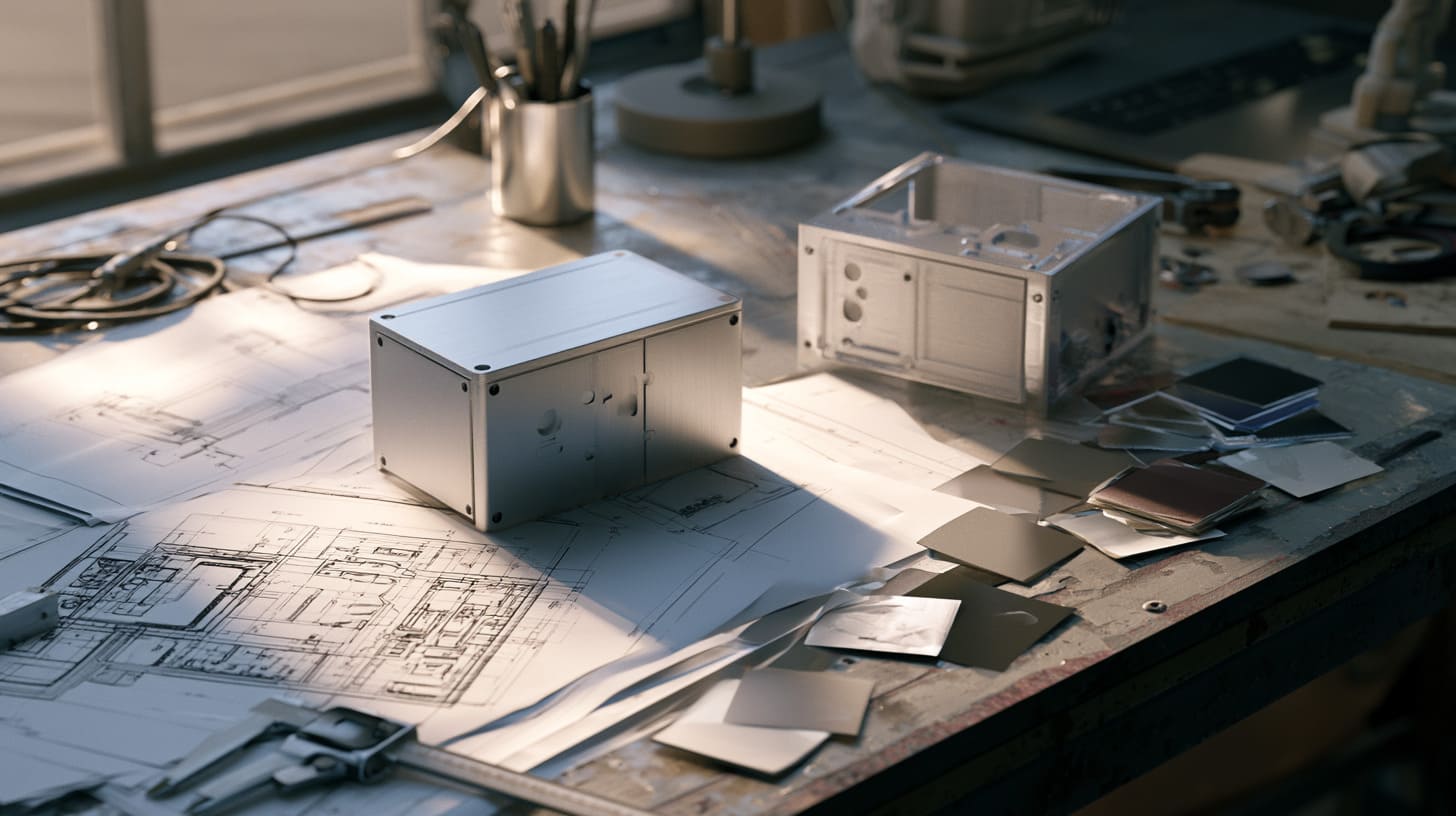
A good quotation needs more than a drawing.
The drawing tells me the shape. But the coating choice needs the working condition, functional needs, and appearance target.
If a buyer only sends a 3D file and says “quote with black finish,” I can give a rough direction. But I cannot fully judge the right coating without more context.
When quotation information is incomplete, I try to ask the missing questions early because a fast quote that ignores coating risk is not really fast; it only moves the problem to the next step.
Basic project information
Before quotation, buyers should provide the basic project information.
| Information | Why it helps |
|---|---|
| Material | Different aluminum types finish differently |
| Manufacturing process | Extrusion, CNC, die casting, and sheet metal have different surface needs |
| 2D drawing | Shows tolerances and critical dimensions |
| 3D file | Helps check structure and assembly |
| Quantity | Affects process choice and cost |
| Target application | Shows functional needs |
| Indoor or outdoor use | Affects protection level |
A 3D file is useful, but a 2D drawing is still important when coating affects tolerance, holes, and functional areas.
Coating requirements
If the buyer already has a finish requirement, it should be written clearly.
Useful information includes:
- Coating type
- Color code
- Gloss level
- Texture requirement
- Sample reference
- Surface appearance standard
- Corrosion requirement
- Salt spray requirement
- Masked areas
- Conductive or non-conductive areas
If the color is important, a physical sample or standard color code is better than a screenshot.
For black finishes, buyers should also specify whether they want matte black, glossy black, textured black, black anodizing, or black powder coating. These are not the same.
Functional requirements
Functional requirements are just as important as appearance.
Buyers should tell the supplier about:
| Requirement | Why it matters |
|---|---|
| IP rating | Affects gasket and coating around sealing areas |
| EMI shielding | Affects conductive surfaces |
| Grounding method | Requires bare or conductive contact points |
| Heat dissipation | Affects thermal contact surfaces |
| Assembly tolerance | Coating thickness must be considered |
| Outdoor exposure | Affects corrosion and UV resistance |
| Logo method | Finish affects printing or engraving result |
If the enclosure is used for electronics, I prefer to know whether the housing has any electrical role. This avoids wrong assumptions.
Supplier judgment point
A good enclosure supplier should review both the drawing and the working condition before confirming the coating.
If the supplier only asks for color and quantity, some risks may be missed. If the supplier asks about grounding, environment, coating thickness, and tolerance, that is usually a good sign.
From my side, I do not ask these questions to make the project slower. I ask them because custom enclosures are connected systems. The finish, structure, gasket, screws, PCB, logo, and final use all affect each other.
A good coating quote should not only answer “how much.” It should also reduce the chance of wrong production.
Conclusion
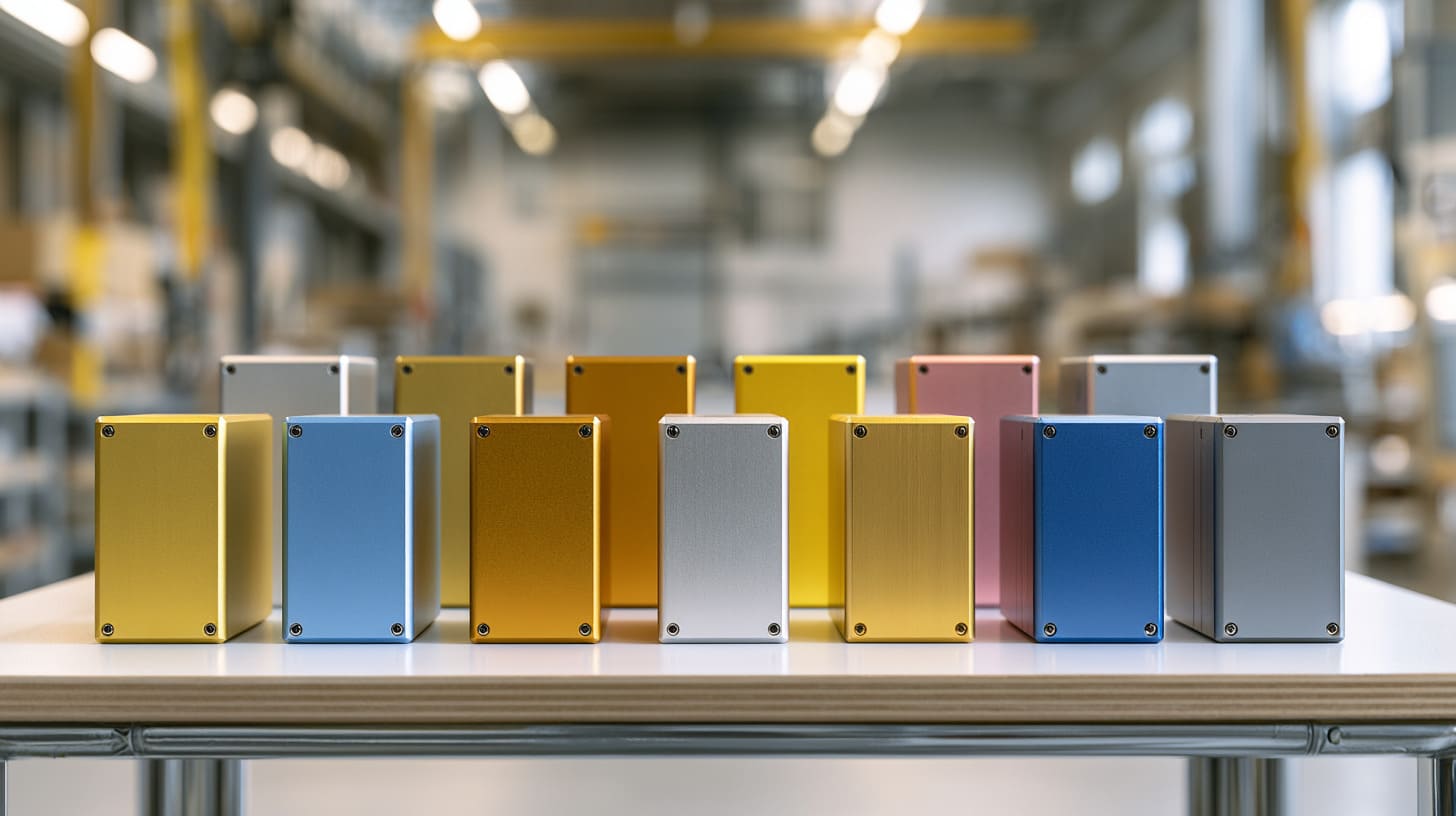
Surface coating selection for aluminum enclosures is a small topic only if we look at it from far away.
Once we move closer, it becomes a real engineering decision.
Anodizing is strong when the customer wants a clean metallic look, better wear resistance, and a professional aluminum feel. Powder coating is strong when the product needs color, branding, texture, and industrial protection. Wet painting is useful when special color or cosmetic control matters. Chemical conversion coating is valuable when conductivity, grounding, EMI shielding, or tight tolerance is important. E-coating, plating, brushing, and polishing each have their own place when the project needs them.
But I do not choose a coating by name first.
I choose it by asking what the enclosure must survive and what job the surface must do.
Will the enclosure sit outdoors?
Will it face salt air?
Will it need grounding?
Will the PCB transfer heat into the housing?
Will the cover slide into rails?
Will the customer judge the product by color and touch?
Will the drawing tolerance still work after finishing?
These questions may look small, but they protect the project.
This is why I believe the best coating choice comes from the real application, not from a default note on the drawing. A finish should support the product, not fight against it.
At MaidaTech, we manufacture custom aluminum enclosures, plastic enclosures, sheet metal enclosures, Raspberry Pi style cases, and other customized enclosures for OEM and ODM customers. Many customers send us drawings, logo files, and special surface requirements. My job is not only to quote the part. My job is also to help check whether the design, finish, assembly, and real use condition can work together.
If you are working on a custom aluminum enclosure project and you are not sure which coating to choose, you can send us your drawing, 3D file, quantity, application, and surface requirement.
We can review the coating choice with the enclosure design and help you avoid problems before production starts.