Skip to content

The expensive part of a plastic enclosure project is often not the resin; it is the point at which everyone believes the tool is finished. Then a buyer asks whether polycarbonate (PC) can become ABS to reduce piece price. The request can be sensible, but after tool steel is cut it is no longer a purchasing-only decision.
On an enclosure program, I treat a late PC-to-ABS proposal as an engineering change. The new grade can alter dimensions, fill, cooling, surface quality, snap fits, screw bosses, approvals, and the way the lid meets its gasket. A trial may run, yet still create a product that is hard to hold in tolerance or approve consistently.
This is not an argument that ABS is inferior. It is often an excellent indoor housing material. The practical question is whether the selected ABS grade can satisfy the same drawing, process window, service conditions, and compliance basis that were used to build the PC tool.
A Mold Is Sized for a Material-and-Process System
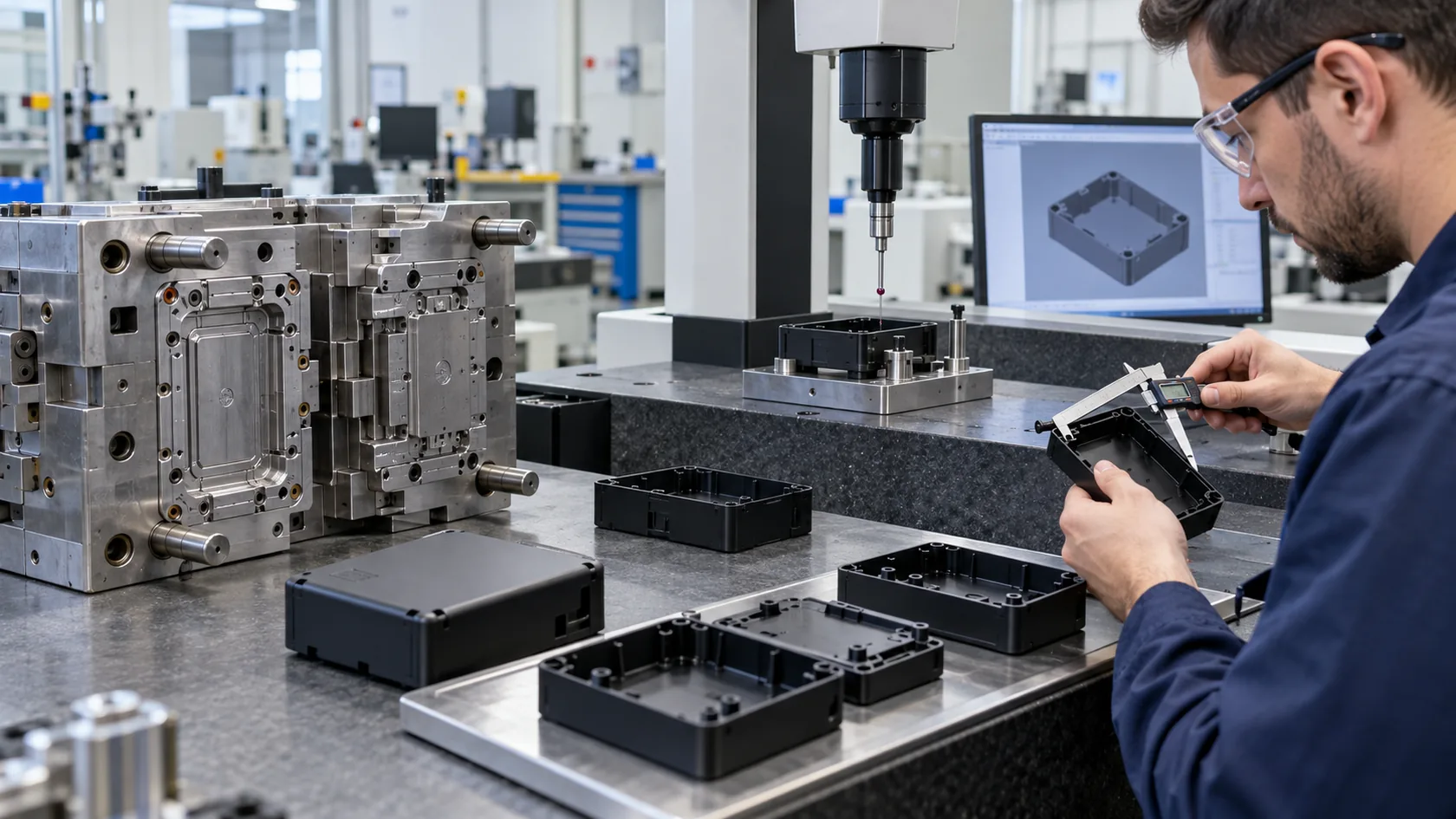
An injection mold is not made for a generic word such as “plastic.” Its cavity dimensions anticipate a specified resin family, grade, flow direction, wall thickness, gate, pack profile, cooling arrangement, and expected shrinkage. Changing any one of those inputs can move the finished dimensions.
Similar nominal shrinkage is not a clearance to switch
One representative injection-molding PC grade, Covestro Makrolon 2605, lists molding shrinkage around 0.60–0.80% under stated test conditions. That is useful reference data, not a universal PC value or a promise of a particular enclosure size. ABS grades have their own ranges, and both materials respond to geometry and processing.
| Tooling input | What can change after an ABS switch | Enclosure consequence |
|---|---|---|
| Shrinkage and anisotropy | Local dimensions and flatness | Lid gap, connector alignment, gasket compression |
| Flow behavior | Fill pattern, weld-line position, packing response | Cosmetic shift, weak-looking knit line, short-fill risk |
| Cooling response | Time to stabilize and residual stress | Warpage, cycle-time drift, inconsistent fit |
| Ejection and draft | Release force and scuffing | Textured walls or ribs may mark or drag |
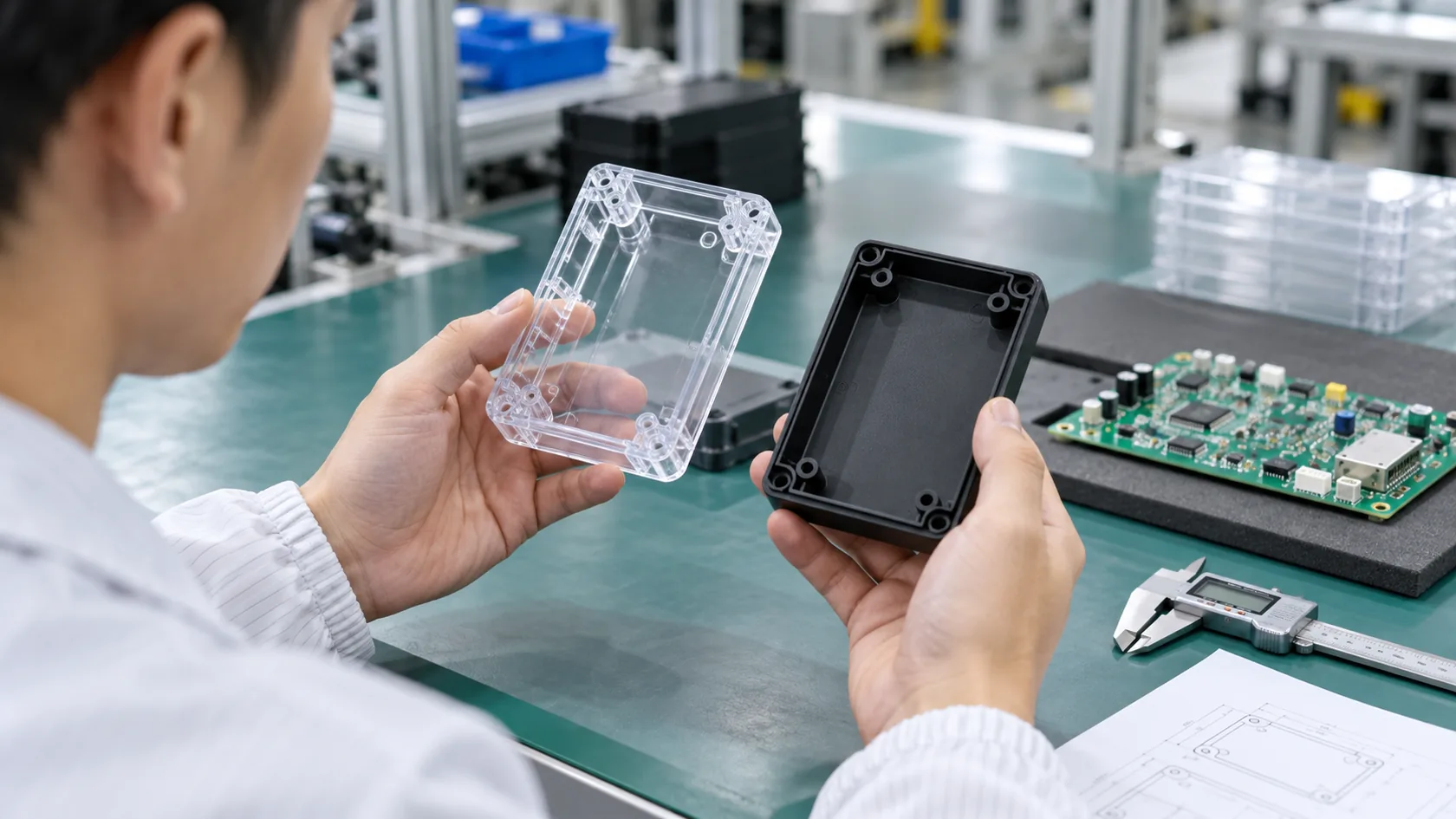
In my experience, a two-cavity trial can look fine while the lid/base match becomes unstable across cavities or over a full production shift. That is why we measure functional interfaces, not only the overall length and width. Once the dimensions are understood, the next risk is how the material fills the existing tool.
The Existing Gate and Runner May No Longer Be Balanced
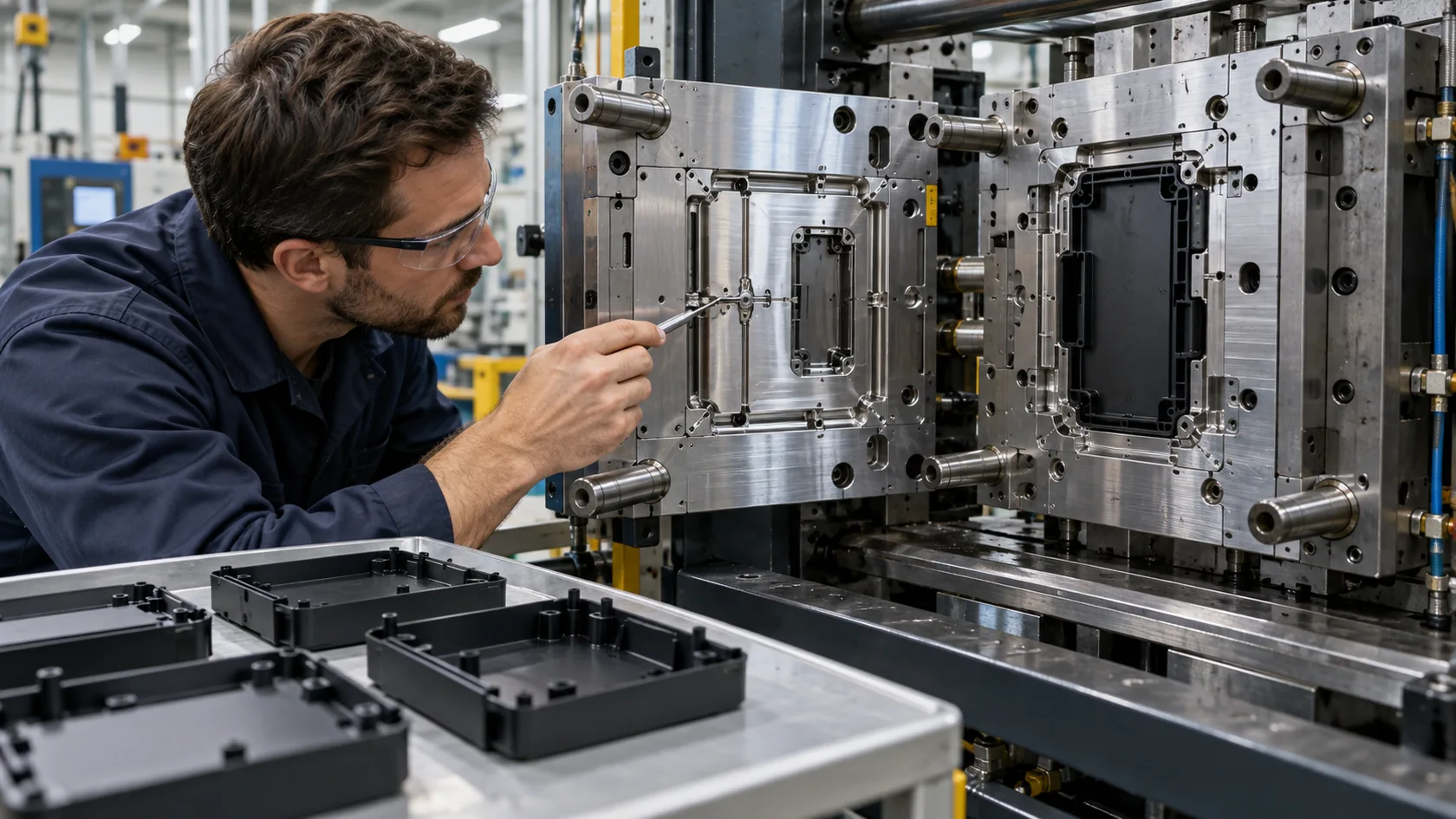
PC and ABS do not share one safe processing recipe. Resin suppliers set grade-specific requirements for drying, melt temperature, mold temperature, injection speed, and residence time. These settings affect viscosity and how pressure reaches far corners, ribs, bosses, and thin sections.
The first defect may be cosmetic, not dimensional
An ABS trial in a PC-designed tool can change the flow-front meeting point, gloss around the gate, sink around a boss, or the visibility of a weld line. A gate sized to fill the original grade may still fill ABS, but “it fills” is not the same as “it packs and looks consistent at the planned cycle time.”
I ask the molder to review the actual tool layout before anyone promises a saving: gate type and location, runner balance, vent condition, shear-sensitive zones, wall-to-rib transitions, and the screw/barrel suitability for the exact resin. A process change may solve one visible issue while pushing residual stress or warpage somewhere less obvious. That flow review should be paired with a cooling review, because the two are tightly connected.
Cooling, Flatness, and Cycle Time Can Move Together
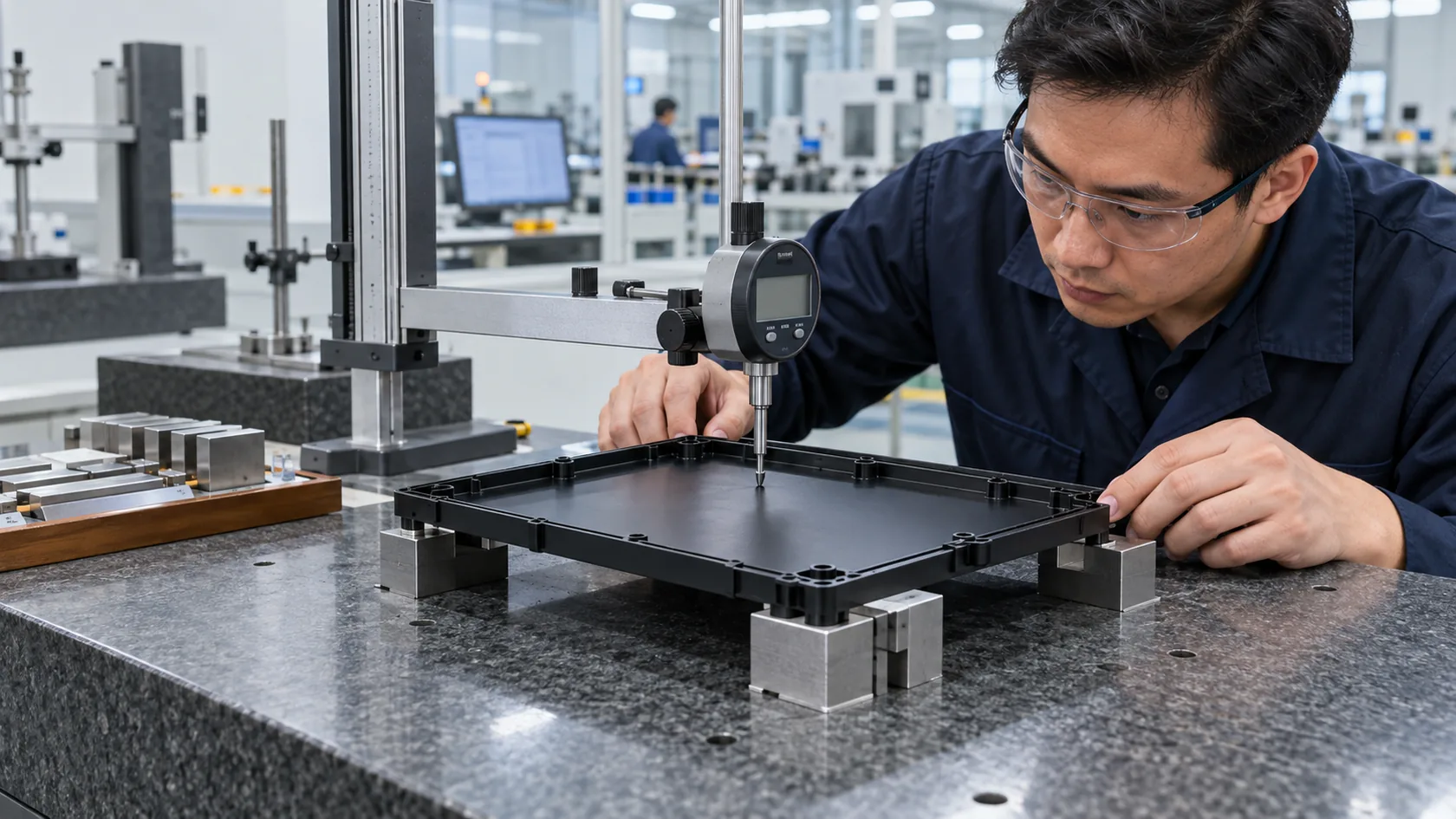
The mold’s water circuits and cycle were optimized around a previous part temperature history. With a material change, a part can leave the tool at a different stiffness and continue to relax after ejection. Flat panels, thin lids, and asymmetrical bases make that risk easier to see.
Do not approve from a warm part
A part measured moments after molding may sit within tolerance, then distort after it cools, is assembled, or spends time in a carton. For enclosure work, I prefer to define the conditioning time, measurement temperature, support fixture, and datums before comparing the PC baseline with ABS samples.
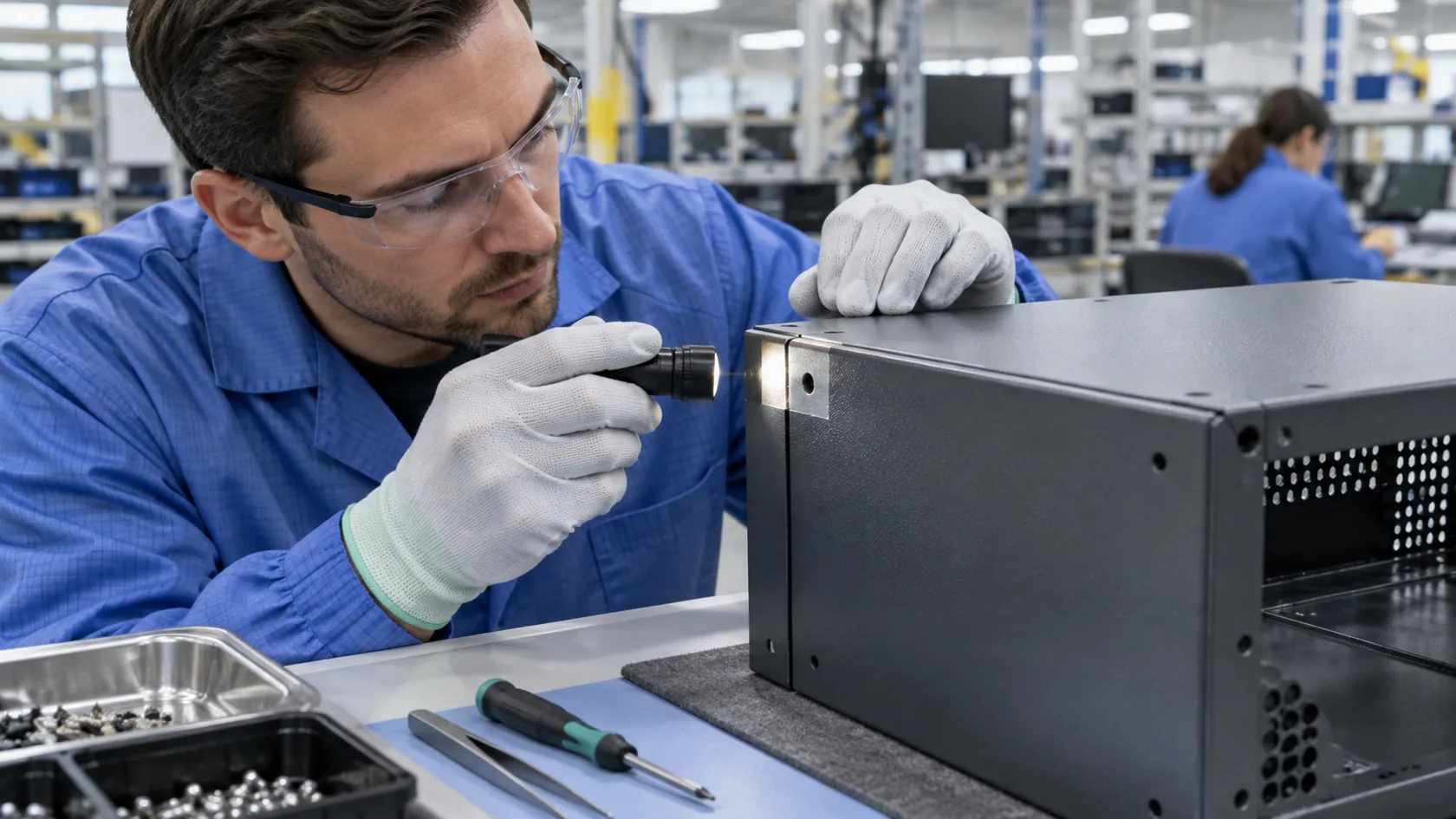
The most useful inspection points are usually functional: PCB standoffs, connector cutouts, screw-boss centers, cover perimeter, latch engagement, and the gasket land. If cycle time must rise to hold those points stable, the apparent resin saving may disappear. That leads directly to the details that see the highest local stress during assembly.
Snap Fits, Screw Bosses, and Inserts Need Revalidation
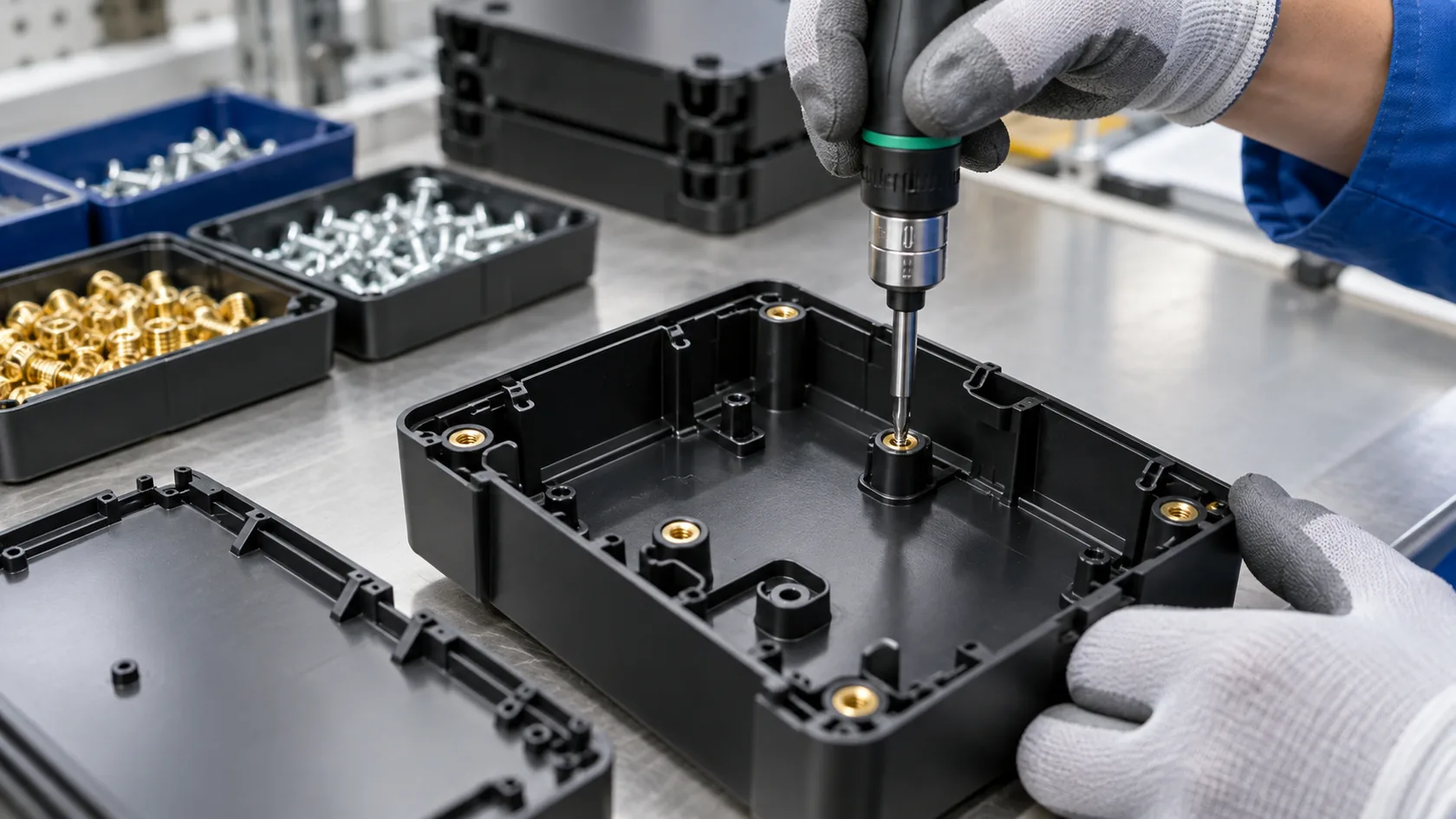
An enclosure rarely fails at its largest flat surface. It usually complains at a snap hook, a screw boss, a threaded insert, a sharp inside corner, or a thin wall surrounding a connector. The original PC design may have used that material’s toughness, stiffness, heat behavior, or stress-crack resistance as part of its safety margin.
Test the real assembly sequence
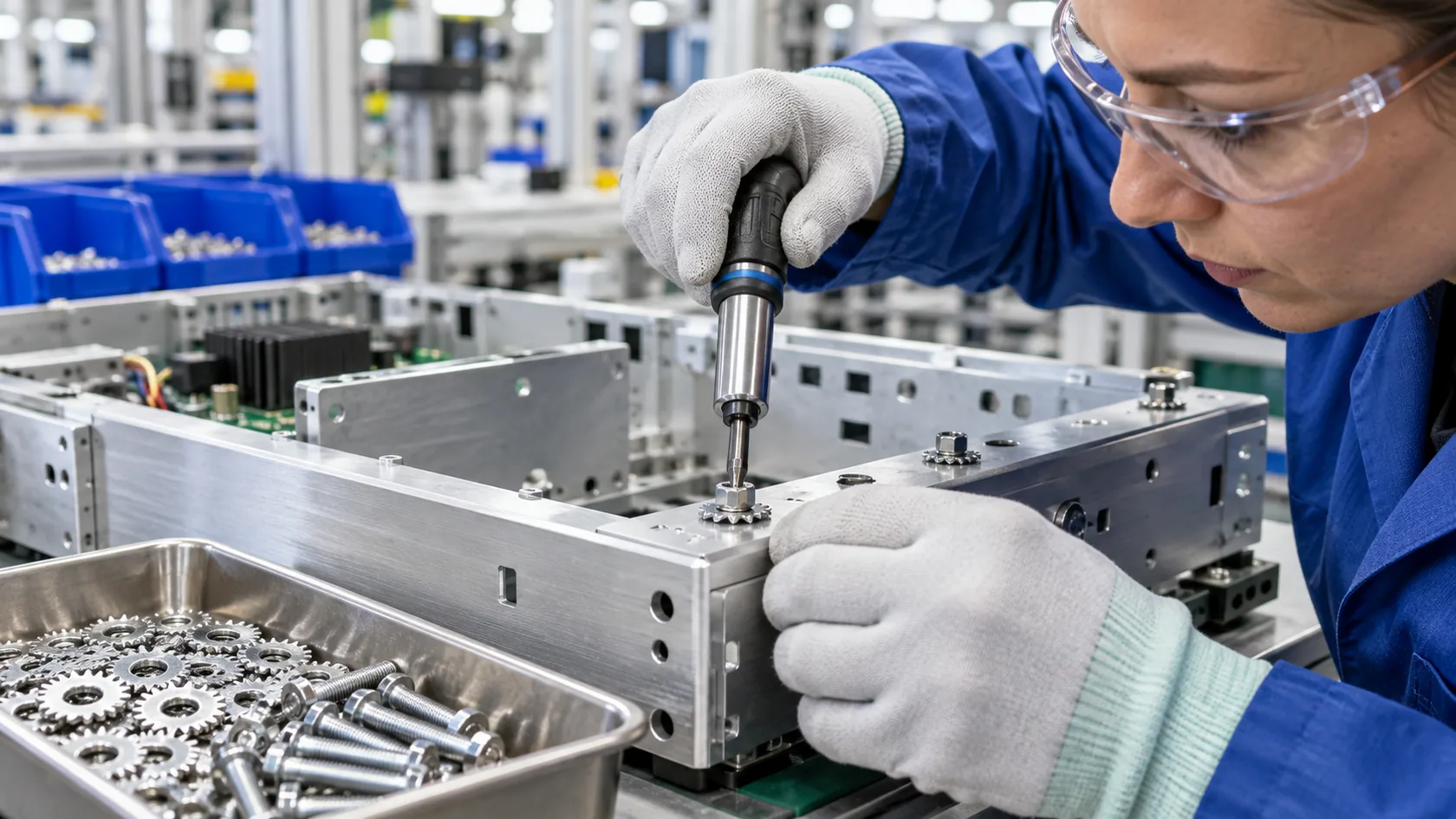
Switching to ABS does not automatically make these features unacceptable. It means they need evidence with the selected grade, color, and production conditions. Check assembly force, repeated opening, screw torque, insert installation, drop/handling exposure if applicable, and the clearance of every mating component.
I would be cautious with a late material change when a lid uses multiple snaps and a central screw boss: a small dimensional shift can make one corner carry the load. In a trial, record breakage, whitening, stripping, deformation, and post-assembly fit. Then repeat after the part has cooled and after the planned aging or environmental exposure. The material change also needs a fresh review of the use environment.
Heat, Chemicals, and Appearance Can Change the Field Result

A PC-to-ABS switch may be commercially attractive for a protected indoor controller. It deserves much more care for a product near heat sources, exposed to cleaners, carried outdoors, or left in a hot vehicle or cabinet. The exact grade, pigment, wall thickness, and real exposure determine the answer.
A resin family is not a complete requirement
Ask what the enclosure sees: internal component temperature and duty cycle; sunlight or UV; cleaning fluid; oil or grease; transport impact; humidity; and the expected cosmetic life. A data sheet can narrow the candidate list, but it cannot validate a finished box under an unstated field condition.
For transparent or translucent features, the issue may be immediate because standard ABS does not provide the same function. For textured opaque housings, the surprise can be a change in gloss, flow marks, color match, or scratch visibility. My preference is to approve an ABS sample in the intended texture and color—not a natural-color resin plaque—before calling the swap a cost reduction.
Compliance Does Not Transfer by Material Name

If the product depends on flammability, electrical, or environmental recognition, the switch must be checked against the exact grade and conditions. UL explains that the UL 746 series covers multiple material characteristics, including mechanical, electrical, thermal, and flammability properties. It is not a blanket pass from one polymer name to another.
Lock the grade, thickness, color, and test basis
UL 94 testing is performed on material specimens; the result must be interpreted with its stated thickness and other conditions. A supplier saying “V-0 ABS” is therefore not enough for an enclosure drawing. Request the resin designation, color, minimum thickness, recognition evidence where required, and the applicable end-product requirement.
The same caution applies to outdoor use, electrical spacing, relative temperature index, and any customer qualification test. I have seen a material-change request arrive with one goal—lower cost—and uncover an approval path that costs more than the resin difference. Once the technical and compliance risks are visible, the business decision becomes clearer.
Compare the Whole Change Cost, Not Only Resin Price

The correct comparison is not PC price per kilogram versus ABS price per kilogram. It is the cost and risk of changing a released manufacturing system.
| Cost or risk item | Question to settle before approval |
|---|---|
| Tool modification | Are gate, vent, cooling, texture, or cavity adjustments required? |
| Trial and scrap | How many runs are needed to establish a capable window? |
| Inspection | Which functional dimensions need new capability evidence? |
| Assembly | Do torque, snap, insert, and mating-part checks still pass? |
| Compliance | Does a grade/thickness/color change trigger review or retest? |
| Supply | Is the exact approved grade available through the planned production life? |
I would also quantify the impact of a slower cycle, increased sorting, higher reject rate, or a second set of buyer samples. On a small or short-lived program, keeping the PC tool configuration may be cheaper. On a high-volume indoor product, a controlled ABS redesign can make commercial sense—but that may be a tooling project, not a quick material substitution.
A Safer PC-to-ABS Change-Control Plan

When the price target is real, I do not reject the idea at the first email. I turn it into a short, documented gate so the buyer can see the risk before spending on trials.
Use the same discipline as a drawing revision
- Define the exact PC baseline: grade, color, texture, revision, approved process window, dimensions, and test history.
- Nominate the exact ABS grade and obtain its supplier processing and property guidance.
- Complete a molder/toolmaker review of shrinkage, filling, gates, vents, ejection, cooling, and any likely steel changes.
- Mold controlled samples, then measure them after agreed conditioning with a functional fixture.
- Re-run assembly, cosmetic, environmental, and compliance checks that the application requires.
- Compare results and total cost against the PC baseline; release only a documented accepted configuration.
The Society of Plastics Engineers is one credible place to follow the broader engineering discipline behind materials and processing, but the evidence for a particular enclosure must come from its own grade, tool, and validation plan. With that plan in place, the final decision is much less emotional.
Conclusion

Switching from PC to ABS after tooling can create manufacturing problems because the tool, resin, process, assembly, and approval conditions were designed as one system. The change can be successful, especially for an appropriate indoor product, but it should be treated as a controlled engineering change rather than a line-item saving.
From the factory side, I would first compare the exact grades and the enclosure’s critical interfaces: gate-to-far-end fill, lid fit, gasket land, bosses, snaps, texture, temperature exposure, and any certification basis. Share the drawing, existing PC grade, target ABS grade, annual volume, and the cost objective; we can then judge whether a trial, a tool adjustment, or a purpose-designed ABS revision is the sensible route.